The Economic Repercussions of Houthi Control over Bab al-Mandab
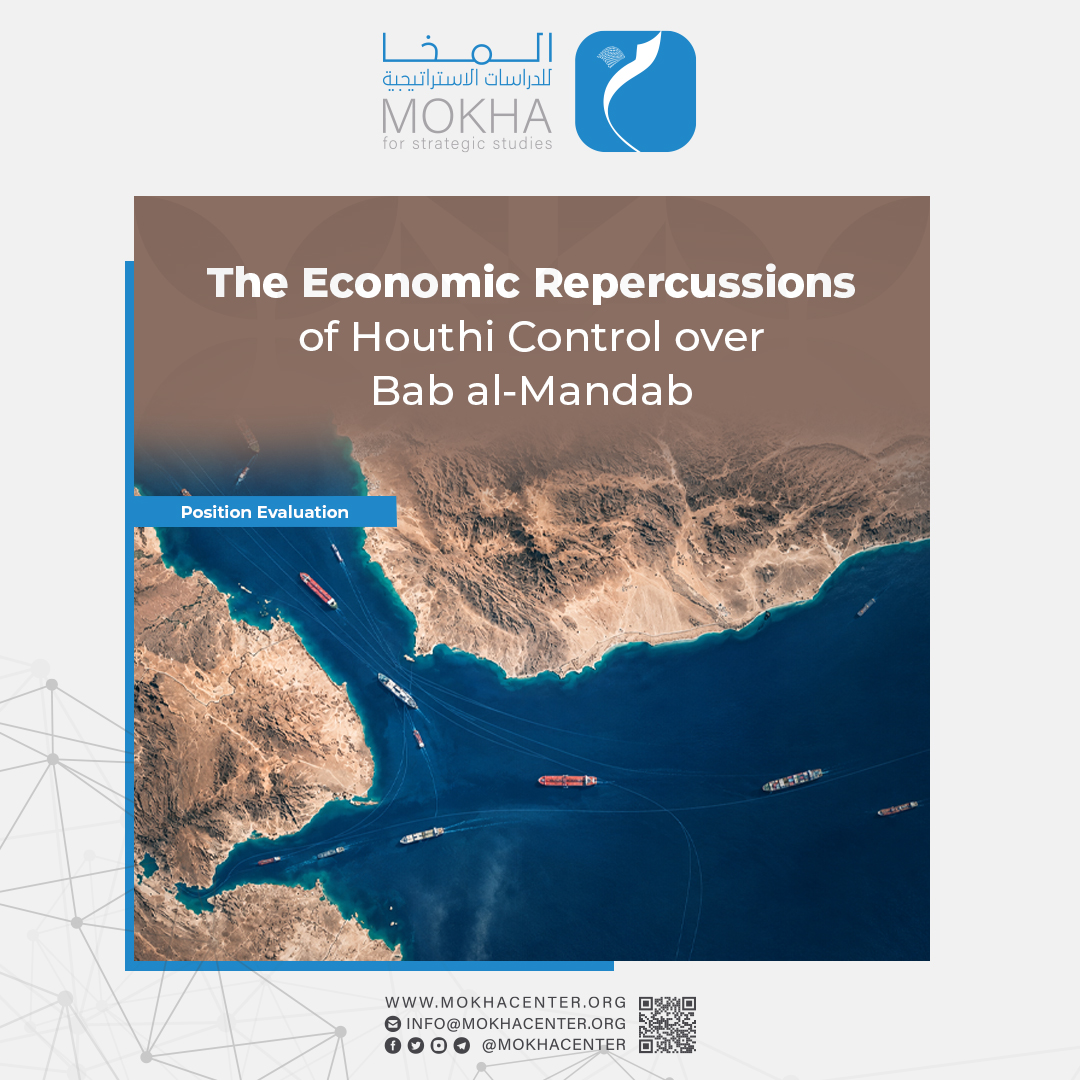
On 10 September, Houthi forces entered Mokha and seized its Red Sea port. The following day, they advanced into Dhubab district, opposite Perim Island. Armed boats subsequently reached the island after government forces withdrew, while the Houthis also took control of the Hanish archipelago and Zuqar Island.
Perim is especially significant because it divides Bab al-Mandab into two channels. A force positioned on the island can, in practical terms, exert direct pressure on the navigable route used by commercial shipping. This changes the nature of the Houthi threat, not simply its scale. Until now, the Houthis possessed weapons capable of threatening vessels from a distance. They now hold positions that could also allow them to stop, inspect, or interfere directly with passing ships.
For insurance markets, the distinction is substantial. The risk of a missile strike can be modelled, priced, and insured. The risk of detention, forced inspection, or direct interference is far harder to quantify and cover, and therefore carries a much higher premium. The timing makes this development more consequential. After Iran nearly shut the Strait of Hormuz following the outbreak of war with the United States on 28 February 2026, Saudi Arabia became increasingly dependent on Red Sea routes for its oil exports. Saudi ports on the Red Sea also assumed greater importance for the Kingdom’s imports and exports, as well as for trade flows serving other Gulf states. In July, the Houthis announced a naval blockade targeting these ports.
The result is a far more serious strategic and economic equation. The two main chokepoints for global oil trade can now be used simultaneously as instruments of pressure aligned with Iranian interests, while the route that was meant to provide an alternative to Hormuz has itself become exposed.
A complete closure of Bab al-Mandab remains unlikely in the near term. The more immediate risk is that passage through the strait becomes significantly more expensive. Higher insurance premiums, greater security costs, rerouting risks, and increased uncertainty for shipping operators are therefore likely to constitute the most immediate economic consequences.
Washington’s Response Threshold:U.S. Interests,Not Allied Interests
Washington’s public messaging draws a careful line around the limits of U.S. involvement. A senior administration official told CNBC that the United States remains focused on its core security interests, including freedom of navigation in the Red Sea, while enabling regional partners to take the lead in managing and resolving security challenges. The official also pointed to continued dialogue with Saudi Arabia.
The State Department has similarly described the protection of commercial shipping in the Red Sea and the Strait of Hormuz as a top priority, pledging to work with partners to deter attacks by Iran and its proxies against commercial vessels and to keep trade flowing. Yet the limits of that commitment are becoming clearer. Reports indicate that Saudi Crown Prince Mohammed bin Salman requested direct U.S. military intervention from the president, but Washington did not agree.
A Pressure Point, Not a Strait to Be Fully Closed
Despite Bab al-Mandab’s strategic importance, a complete closure may not be the Houthis’ preferred option, judging by statements from the group’s leaders. The strait’s value lies in the ability to threaten shipping and influence its movement. Closing it altogether would fundamentally change the nature of the crisis, turning it into a direct international confrontation.
More importantly, a prolonged closure could prompt major powers to establish broader international arrangements to secure the passage, potentially reducing the ability of local and regional actors to shape control over Yemen’s coastline and islands.
The economic consequences would also extend well beyond the United States and Europe. China, one of Iran’s largest economic partners, has a major interest in keeping the route open. A significant share of Chinese trade with Europe moves through the Red Sea and the Suez Canal. Sustained disruption would mean higher freight costs, longer delivery times, and tighter margins for Chinese exporters.
Europe and China Share the Same Interest
Europe is among the parties most exposed to disruption because of its dependence on the Red Sea–Suez corridor for trade with Asia. Every sustained reduction in shipping through the route adds pressure to supply chains and raises the cost of trade.
China and Europe therefore share a basic interest: keeping Bab al-Mandab open. If disruption intensifies, affected states could become increasingly willing to support broader international measures to protect commercial navigation.
For this reason, the more likely scenario is not a complete closure of Bab al-Mandab, but calibrated pressure on shipping: increasing risk, threatening or targeting selected vessels, and raising the economic cost of passage without crossing the threshold that would trigger a large-scale international response.
In this sense, Bab al-Mandab retains its greatest value as a pressure point as long as the possibility of further escalation remains credible. Pushing that leverage to its limit, however, could prove counterproductive, provoking precisely the kind of international intervention that would reduce the Houthis’ ability to exploit the strait as a strategic asset.
Potential Scenarios
The most likely scenario is continued pressure on commercial shipping without a full closure of the strait. This could take the form of raising risks for selected vessels while allowing others to pass, potentially reducing traffic by a further 10–25%, pushing up insurance and freight costs, and prolonging the decline in Suez Canal revenues.
A second scenario is intermittent escalation against specific vessels. A complete closure remains the least likely option because of its high economic and political cost and the risk that it would trigger a broader international intervention to secure the passage.
| YEMEN WOULD BEAR THE HEAVIEST OVERALL LOSSES
Higher insurance premiums and freight rates for shipments to Hodeidah, Aden, and Mokha would weaken import flows in a country heavily dependent on imported food and fuel. This would push up prices for basic goods, place further pressure on the Yemeni rial, and erode household purchasing power. Port and customs revenues, which finance part of public spending, would also decline, while humanitarian deliveries, fishing, coastal transport, and other maritime activities along the western coast could be disrupted. These effects could persist even after hostilities subside. |
Beyond Yemen, Egypt would face the most immediate fiscal loss through reduced Suez Canal traffic, while Saudi Arabia would incur higher logistical costs. Europe and China would primarily absorb the impact through higher freight, insurance, and transport costs.
| INDICATORS TO WATCH
Several indicators can help track the direction of the crisis: the number of vessels transiting the strait, tanker movements, changes in insurance premiums, and any attempt to impose fees or require permits for passage. The latter would be particularly significant, as it could indicate a shift toward a new phase in which protection of the strait becomes increasingly internationalized. China’s role would also be important, given its strong interest in preventing a complete closure. |
The most consequential scenario would be a shift from episodic maritime coercion to a system of maritime rent extraction, with the Houthis imposing transit fees or passage permits on commercial vessels, drawing in part on the Iranian model in the Strait of Hormuz. Such a shift would provide the group with a regular source of revenue while creating a degree of implicit recognition of its control over the passage. It would also transform temporary coercion into a more durable system of maritime toll-taking that would be difficult to reverse. More broadly, it could set a precedent for other actors to monetize strategic geography, while prompting insurers and shipping companies to price political risk as a permanent operating cost rather than a temporary disruption. That, in turn, would accelerate pressure for the internationalization of maritime security in Bab al-Mandab.
