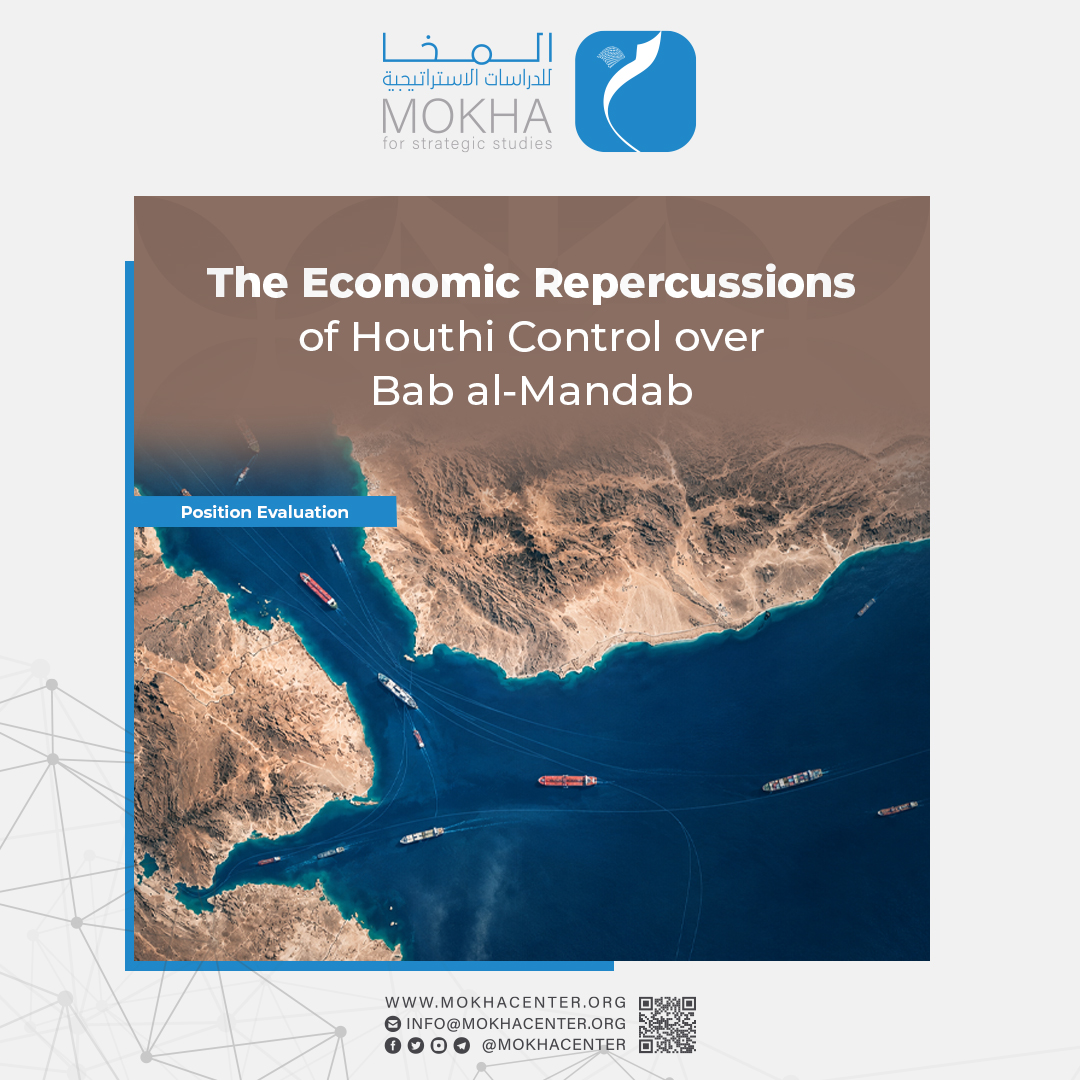
Bab al-Mandab in the Iranian–American–Israeli Triangle: Post-Agreement Scenarios

Introduction
The situation assessment examines the transformations that Bab al-Mandab Strait has witnessed since the outbreak of the war in Gaza in October 2023, and how it has shifted from an international trade route into a central arena within the Iranian–American–Israeli conflict equation. It also addresses the repercussions of the Iranian–Israeli–American war in 2026, the variables associated with the Islamabad negotiations, and the post-agreement scenarios following a potential understanding between Washington and Tehran.
The assessment shows that Bab al-Mandab has become part of a broader regional conflict equation based on the use of maritime geography as a tool of deterrence and political pressure. Iran views the strait as a strategic card within its policies of “forward defense” and “unity of arenas,” using the threat of disrupting it, or linking it to the Strait of Hormuz, to strengthen its negotiating position and offset Western pressure. In contrast, the United States seeks to protect freedom of navigation and prevent the strait from becoming a tool of geoeconomic pressure, yet it faces the limits of military power in deterring the Houthis or decisively eliminating their capabilities. Israel, meanwhile, views the Houthi threat as a direct challenge to its economic and strategic security and pushes toward more escalatory options to prevent the continued disruption of its maritime interests. As such, Bab al-Mandab has become a point of convergence between Iranian deterrence, American containment, and Israeli escalation, while also forming part of a “dual chokehold” system linked to both Bab al-Mandab and the Strait of Hormuz.
The assessment further explains that the Iranian–Israeli–American war in 2026 has placed the strait back at the heart of the regional confrontation, at a time when the Islamabad negotiations between the United States and Iran, with Qatari participation, have emerged as the most influential variable shaping the future of the crisis. The proposed agreement is based on halting military operations across multiple fronts, including Lebanon, and lifting the naval blockade on Iran in exchange for reopening the Strait of Hormuz. Meanwhile, the Houthis seek to include issues related to economic sanctions and terrorist designation within any broader understandings concerning the Axis of Resistance. This makes the future of Bab al-Mandab largely dependent on the outcomes of these negotiations and the nature of the accompanying understandings.
Based on these dynamics, the situation assessment presents four post-agreement scenarios. The first scenario involves comprehensive regional escalation and a deepening of geoeconomic strangulation through the continuation of Houthi attacks and the expansion of regional confrontation. The second scenario is based on the success of American–Iranian de-escalation while the Houthi threat continues independently due to local and regional considerations. The third scenario assumes the emergence of a fragile agreement or temporary framework of understanding that does not address the roots of regional competition, leading to the continued use of pressure through proxies, the transfer of tensions to other arenas, and the Red Sea remaining vulnerable to intermittent escalation. The fourth scenario assumes a comprehensive diplomatic breakthrough that leads to broader regional settlements, including in Yemen and Gaza, and positively affects international maritime security by ending Houthi threats and creating a more stable environment in the Red Sea.
Source
Sainz Caparroso, S. and Rodríguez, Á. (2026) ‘Analysis of Maritime Geopolitics in Early 2026: The Red Sea Factor’, Zenodo, March. Available at: https://zenodo.org/records/18457391 [Accessed 9 June 2026].
UNCTAD (2026) The State of Global Shipping: Mid-2026 Assessment. Geneva: United Nations Conference on Trade and Development, May. Available at: https://unctad.org/publication/shipping-assessment-2026 [Accessed 9 June 2026
Sea-Intelligence (2026) Structural Shifts in East-West Trade Routes. Copenhagen: Sea-Intelligence ApS, April.
Drewry (2026) World Container Index – June 2026 Report. London: Drewry Shipping Consultants Ltd. Available at: https://www.drewry.co.uk/world-container-index [Accessed 9 June 2026].
Middle East Monitor (2026) ‘Houthi attacks slash Eilat port revenue to near zero, Israeli newspaper reports’, Middle East Monitor, 13 January. Available at:
https://www.middleeastmonitor.com/20260113-houthi-attacks-slash-eilat-port-revenue-to-near-zero-israeli-newspaper-reports/ [Accessed 9 June 2026].
Calcalist (2026) ‘The Cost of Circumvention: How Red Sea Attacks Reshaped Israeli Imports’, Calcalist, 5 February.
Etkes, H. and Feldman, N. (2026) ‘The Strategic Cost of Maritime Disruption for Israel’, INSS Insight, No. 1854. Tel Aviv: Institute for National Security Studies
‘Stop the Folly or Face Consequences in Hormuz, Bab al-Mandeb’, Mehr News Agency, 8 June 2026,
https://en.mehrnews.com/news/245145/Stop-the-folly-or-face-consequences-in-Hormuz-Bab-al-Mandeb [accessed8 June 2026]
‘From Hormuz Strait to Red Sea Resistance’s New Security Belt’, Mehr News Agency, 8 June 2026, https://en.mehrnews.com/news/245180/From-Hormuz-Strait-to-Red-Sea-resistance-s-new-security-belt [accessed 8 June 2026]
Blanchard, C.M. (2026 ) Yemen: Conflict Overview and U.S. Policy. Washington, DC: Congressional Research Service, April. Available at: https://crsreports.congress.gov/product/pdf/R/R46981 [Accessed 9 June 2026].
Trump, D. (2025 ) Statement on Operation Rough Rider, The White House, 15 March. Available at: https://www.whitehouse.gov/statements/2025/03/rough-rider [Accessed 9 June 2026].
Johnsen, G. (2025 ) ‘Operation Rough Rider: An Assessment’, CTC Sentinel, 18(6), June. Available at: https://ctc.westpoint.edu/operation-rough-rider-an-
/ [Accessed 9 June 2026].
Whalley, N. (2025 ) ‘US Leaves Yemen Worse Than It Found It’, Sana’a Center for Strategic Studies, 9 May. Available at: https://sanaacenter.org/publications/perspectives-and-analyses/24753 [Accessed 9 June 2026].
‘US Carrier Strike Group Reroutes Around Africa to Avoid Houthi Anti-Ship Missiles’, USNI News, 18 April 2026, https://news.usni.org/ [accessed 10 June 2026]. Citrinowicz, D. and Abdi, H. (2026 ) ‘The Houthi Threat to Israel and Somaliland — Characteristics and Policy Recommendations’, INSS Insight, No. 2134, 29 April. Tel Aviv: Institute for National Security Studies. Available at: https://www.inss.org.il/publication/houthi-threat-israel-somaliland/ [Accessed 9 June 2026].
International Crisis Group (2026 ) Bab al-Mandab, Yemen, Trigger List: Iran-US-Israel. Brussels: ICG, April. Available at: https://www.crisisgroup.org/trigger-list/iran-usisrael-trigger-list/flashpoints/bab-al-mandab-yemen [Accessed 9 June 2026].
Guzansky, Yoel, ‘The Red Sea Rift: Growing Divergence between US and Israeli Strategies toward the Houthi Threat’, Institute for National Security Studies (INSS) Insight, No. 214, 18 June 2025,
Guzansky, Yoel, ‘The Red Sea Rift: Growing Divergence between US and Israeli Strategies toward the Houthi Threat’, Institute for National Security Studies (INSS) Insight, No. 214, 18 June 2025, https://www.inss.org.il/wp-content/uploads/2025/12/Memo-248_Digital.pdf [accessed 9 June 2026]. Middle East Institute (2025) ‘US Policy in the Middle East: Third Quarter 2025 Report Card’, MEI, 27 October. Available at: https://mei.edu/report/us-policy-middle-east-third-quarter-2025-report-card/ [Accessed 9 June 2026].
Abu Alasrar, F. (2026) ‘What the Red Sea Conflict Between the U.S. and the Houthis Taught Iran’, Stimson Center, 15 May. Available at: https://www.stimson.org/2026/what-the-red-sea-conflict-between-the-u-s-and-the-houthis-taught-iran/ [Accessed 10 June 2026].
Chatham House (2025) ‘Despite the Gaza ceasefire, the Israel–Houthi conflict may resume’, Chatham House, 24 October. Available at: https://www.chathamhouse.org/publications/the-world-today/2025-09/despite-gaza-
ceasefire-israel-houthi-conflict-may-resume [Accessed 10 June 2026].
Yemen Conflict Observatory (2026) ‘Houthis declare full navigation ban on Israeli vessels’, Yemen Conflict Observatory, 8 June. Available at: https://yemenconflictobservatory.org/2026/06/08 [Accessed 10 June 2026].