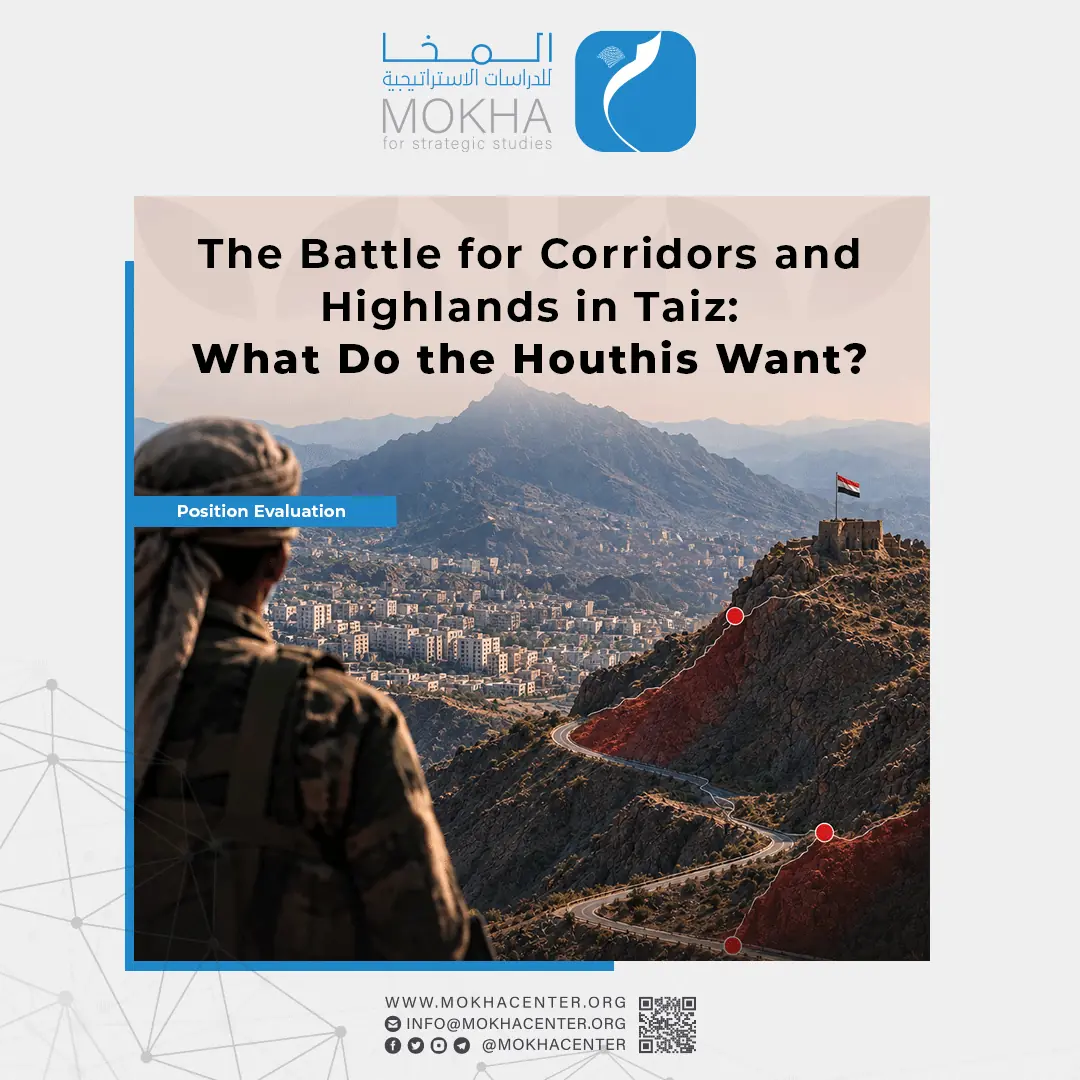
The Battle for Corridors and Highlands in Taiz: What Do the Houthis Want?
العربية : Read this article in
September has brought a significant shift on Yemen’s western coast. Military setbacks in Mokha and along parts of the coastal strip have allowed Houthi forces to consolidate their position on the Red Sea coast and redirect pressure towards western Taiz. The group appears to be seeking to complete an “arc of encirclement” around the governorate by threatening the routes connecting its interior to its main supply artery—the Lahj–Tur al-Bahah–Al-Turbah road—with the broader aim of reimposing a full siege on Taiz city.
The fighting is now concentrated along Taiz’s western approaches, where the terrain largely dictates the course of operations. Clashes centre on commanding high ground and strategic corridors that control movement between Lahj, which serves as a key supply corridor, and the interior of Taiz. Progress on any one axis therefore depends heavily on developments along adjacent fronts and on securing the roads and access routes behind advancing forces.
Al-Kadha, Rasin, Bani Omar and Jabal Jirdad are among the key positions controlling the movement of supplies and reinforcements. Yemeni government forces and the Popular Resistance are therefore seeking to hold this strategic belt. Its loss would significantly strengthen the Houthis’ ability to isolate Taiz city, disrupt government supply lines and increase military pressure across the surrounding fronts.
Strategic Importance and the Houthis’ Focus on Taiz
Taiz is one of the most important geographic and demographic centres in Yemen’s current conflict. Its population, political and cultural weight, and military significance make the outcome of the battle for the governorate a key factor in shaping Yemen’s political and military landscape. Despite years of fighting from 2015 to September 2026, Taiz has remained outside full Houthi control and has continued to play a prominent national role in opposing the Houthi project, which seeks to replace Yemen’s pluralistic democratic republican system with a theocratic imamate in which political power is monopolised by a sectarian lineage. Control of Taiz would therefore represent more than a territorial gain; it would weaken one of the most prominent centres of Yemen’s republican project.
Taiz is also militarily important because of the mountainous terrain across its western and southwestern approaches. Control of these highlands provides leverage over key movement and supply routes and helps secure Houthi positions along the Red Sea coast and around the Bab al-Mandab Strait. For the Houthis, the battle therefore extends beyond the capture of tactical positions to an attempt to establish a new military balance that would constrain the movement of forces aligned with the legitimate government and limit coordination between fronts.
From Ground Control to Maritime Leverage
The significance of Taiz’s western and southwestern highlands extends beyond their immediate value in ground combat to the coastal domain and maritime security. Firm Houthi control of elevated, fortified positions with suitable lines of communication would enhance the group’s surveillance and reconnaissance capabilities and increase its ability to exert pressure on overland routes leading to Yemen’s Red Sea coast, the Bab al-Mandab Strait and large parts of the Gulf of Aden.
Available analysis suggests that the Houthis are seeking to develop dispersed and mobile combat capabilities that take advantage of the complex mountainous terrain of western and southwestern Taiz, reducing their reliance on fixed military positions along the coast that are easier to target, as is currently the case in Mokha and Dhubab. The strategic value of this deployment lies in an attempt to offset the technological superiority of the emerging international and regional maritime coalitions in the Red Sea by developing a geographic infrastructure that provides concealment, flexibility and multiple sites for launching anti-ship missiles and drones and deploying radar systems. This would increase the cost and complexity of counter-strikes while helping the Houthis protect the gains they have made along the coast.
Key Frontlines and Operational Axes
Fighting in Taiz is spread across several fronts, but has recently become concentrated on the western front, particularly around Al-Kadha, Jabal Numan, Bani Bakari in Jabal Habashi, Al-Sharajah, Rasin, Al-Alqamah and Jirdad. These positions are of particular importance because they lie on high ground directly overlooking movement and supply routes between Taiz and Lahj governorates.
From a military and operational perspective, Al-Kadha serves as the main gateway to the western axis and provides the link towards the coast. Numan, Bani Bakari and Al-Sharajah occupy commanding high ground that provides fire control over the surroundings of Jabal Habashi and the routes leading into the interior. Further south, Rasin, Al-Alqamah and Jirdad form a strategic chain of highlands overlooking the Al-Turbah–Tur al-Bahah road, which connects Taiz with Lahj.
Despite the significant losses they have sustained, the Houthis are seeking to advance towards these highlands, seize control of them, establish fortified fighting positions and link them together in order to encircle Taiz’s main supply artery. The Yemeni Armed Forces and the Popular Resistance, meanwhile, are focused on preventing the Houthis from establishing this geographic link and on holding the key positions that secure the road. Success on this front is therefore measured less by the amount of territory held than by the ability to exert pressure on the supply route and maintain the connection between Taiz and southern Yemen.
Constraints on a Houthi Breakthrough in Taiz
Despite the recent escalation, the Houthis face a combination of structural constraints and operational challenges that make a decisive outcome in Taiz difficult and costly.
Why Is a Houthi Breakthrough in Taiz Difficult?
The Houthis face several factors in Taiz that make further advances difficult and costly. The first is the governorate’s mountainous terrain. Control of any area often requires first securing the surrounding high ground, giving government forces greater scope to monitor Houthi movements and prevent them from advancing easily. Fighting inside Taiz city and its neighbourhoods adds another layer of difficulty, as attacking forces lose some of the advantage provided by heavy weapons, while further progress depends on controlling closely connected positions and having detailed knowledge of the terrain.
The Houthis also lack a significant social base in Taiz. The governorate’s civic character and strong republican tradition are incompatible with a model of rule based on sectarian wilaya and ideological mobilisation. As a result, any military advance could amount to control over territory without equivalent control over the population, creating continuing security and administrative burdens that could make the cost of holding Taiz higher than the cost of reaching it.
Local forces also know the area well and have years of combat experience within the governorate. The presence of multiple forces and formations defending different fronts means that the loss of one position would not necessarily lead to the collapse of the wider front. Taiz’s links to southern areas also provide government forces with routes for movement and resupply. Taken together, these factors make achieving a decisive outcome in Taiz a prolonged and costly undertaking, even if the Houthis are able to make gains in some positions.
Future Scenarios
Scenario One: Continued Attrition and Stabilisation of the Front Lines (Most Likely Scenario)
Overview: Fighting remains confined to the western axes, with limited shifts in control over some of the high ground, but without either side being able to produce a decisive strategic change in the military balance.
Drivers: The difficult and interconnected mountainous terrain, together with the continued deployment of reinforcements by both sides to Al-Kadha, Numan, Rasin and Jirdad to consolidate positions and prevent breakthroughs.
Outcome: The battle develops into a prolonged war of attrition focused on wearing down military capabilities and maintaining fire control over the mountain corridors, without fundamentally changing the nature of the conflict.
Scenario Two: Expansion of the Offensive and Reimposition of a Full Siege (Most Dangerous Scenario)
Houthi forces achieve a battlefield breakthrough on Taiz’s western front and consolidate their positions there, before expanding the offensive towards the axes linked to Al-Hawban and the approaches to Taiz city, with the aim of restricting the movement of government forces and cutting supply and reinforcement routes.
Drivers: The Houthis seek to exploit their battlefield gains to increase pressure on the supply lines leading into Taiz, consolidate their military presence in Al-Kadha and the surrounding highlands, control key access routes and maintain sustained pressure on them. This could enable the group to reimpose a siege on Taiz city and shift the battle from fighting on the outskirts of the governorate to a direct threat to the city and its population, making this the most dangerous scenario for Taiz.
Scenario Three: A Government Counter-Offensive Restores the Geographic Balance
Under this scenario, the Yemeni Armed Forces and the Popular Resistance would absorb the shock resulting from Houthi control of Mokha, Dhubab and the coastal areas extending towards Bab al-Mandab, before launching counter-operations in coordination with the southern and coastal fronts to relieve pressure on Taiz’s western highlands.
Drivers: The difficult terrain and the attrition suffered by attacking Houthi forces could be used to the advantage of government-aligned forces, alongside the establishment of a joint operations room linking the Taiz, Lahj and coastal fronts. Regaining control of key positions in Al-Kadha and Rasin, securing the vital supply route through Tur al-Bahah, and establishing a degree of battlefield deterrence could force Houthi forces to pull back to the positions they held before the current escalation.
Concluding Assessment and Policy Considerations
Available evidence suggests that the battle on Taiz’s western front is likely to continue as a high-cost war of attrition. The Houthis are seeking to turn their recent gains along the western coast into a permanent siege of Taiz’s large demographic and political bloc, while using the governorate’s western and southwestern highlands as positions from which to project influence towards the Red Sea and Bab al-Mandab.
To prevent the most dangerous scenario from materialising and avoid the reimposition of a full siege, conditions on the ground require the immediate adoption of the following measures:
- Coordinate field operations: Strengthen military coordination and establish a joint operations room bringing together the Taiz and Lahj fronts and forces deployed around the coast to secure the Rasin–Jirdad–Tur al-Bahah triangle.
- Fortify the vital supply artery: Strengthen defensive lines and forward fortifications along the mountain range overlooking Taiz’s only supply route to ensure that it cannot be cut or brought under Houthi fire control.
- Capitalise on local opposition and Taiz’s republican tradition: Draw on societal rejection of Houthi rule and the republican legacy that has sustained resistance, while turning the difficult mountainous terrain into zones of continuous attrition for advancing Houthi forces, preventing them from consolidating their positions and establishing mobile launch bases.
