From “Death to America” to a Non-Targeting Agreement: The Houthis’ Secret Talks with the United States
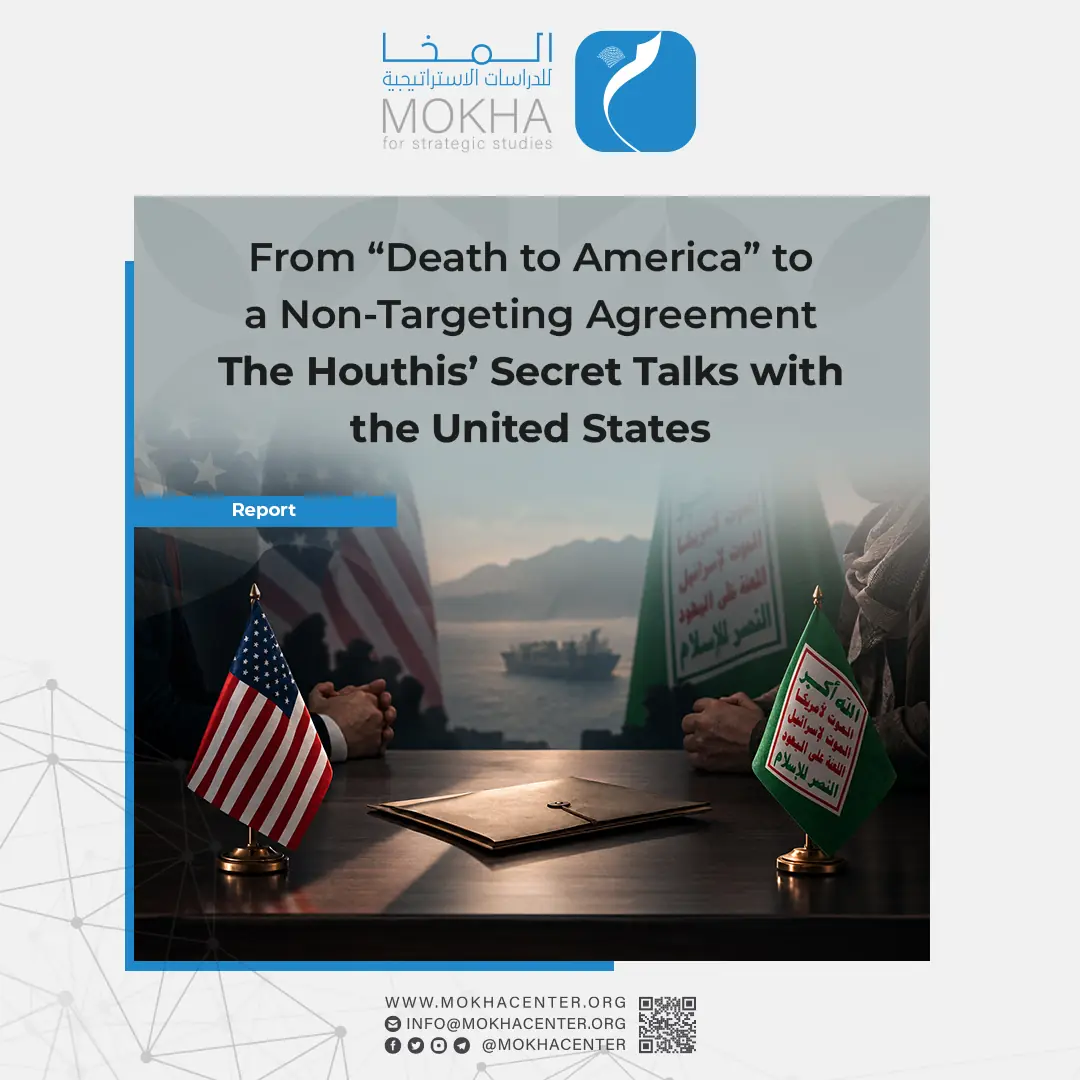
Between the slogan “Death to America” and sitting down to negotiate with the Americans, the Houthis appear, at first glance, to face an obvious contradiction: how can a movement that presents the United States as a central enemy in its ideological mobilization also send messages to Washington, seek de-escalation, and reach understandings with it?
Yet the more precise question is not whether the Houthis have negotiated with the United States. That is a publicly documented fact. The real questions are: What did they negotiate over, through which channels, what did they actually gain, and how did they present those outcomes to their own supporters?
From the contacts acknowledged by the U.S. State Department in 2015 to Oman’s announcement of the May 2025 agreement, a body of evidence has accumulated that carries clear political significance without any need to invoke conspiracy theories.
What Does Hostility Toward the United States Mean in the Houthi Ideological Framework?
In a study published by Chatham House in February 2015, researcher Peter Salisbury traces the movement’s origins to the Zaydi revivalist milieu and the Believing Youth movement, followed by the increasingly anti-American rhetoric of Hussein Badr al-Din al-Houthi. Salisbury also points to the influence of Iran’s revolutionary model on the sarkha, the Houthis’ signature rallying slogan.
He makes an important observation, however: ideological conviction existed alongside efforts to adapt the movement’s public rhetoric in order to broaden its appeal. This provides a useful lens for understanding both the movement’s political behaviour and the choices of its leadership.
There is therefore no need to assume that the Houthis do not believe in their own slogan in order to explain their willingness to negotiate. A more plausible interpretation is that ideological conviction and practical selectivity can coexist: the United States may remain an enemy within the Houthi ideological worldview, while avoiding direct confrontation with it may serve a temporary strategic interest.
The political issue lies in how such arrangements are presented to the movement’s supporters: Does the Houthi leadership openly acknowledge that it has entered into a limited bargain, or is its audience expected to regard every escalation as a victory and every retreat as another victory?
A particularly important documentary starting point is U.S. Embassy Sana’a cable 09SANAA2185, dated 9 December 2009. The cable, later published through WikiLeaks, focused on the Houthis’ identity and the motivations behind their fighting.
It stated that the embassy’s policy at the time was to avoid direct contact with the Houthis out of sensitivity to the Yemeni government’s position. Information was instead gathered through intermediaries and other sources, including Hassan Zaid.
The cable also noted the distinction, at that stage, between the movement’s anti-American rhetoric and the fact that U.S. citizens and interests were not being targeted. Its significance lies in showing that U.S. officials had already identified a gap between rhetoric and conduct years before negotiations with the Houthis became publicly acknowledged.
Confrontational Rhetoric and Channels of Engagement
The period between 2009 and 2013 provides important context for understanding the foundations of Washington’s later approach to the Houthis. A U.S. Embassy cable from Sana’a dated December 2009 noted that the embassy’s policy was to avoid direct contact with the group out of sensitivity to the Yemeni government. At the same time, however, it distinguished between the Houthis’ strongly anti-American rhetoric and their actual conduct: at that stage, the group was not targeting U.S. citizens or interests. This distinction offers insight into how Washington viewed the Houthis at the time and where it placed them within its broader assessment of threats in Yemen.
In this context, the account of Dr. Mohammed Qayzan, Undersecretary at Yemen’s Ministry of Information, carries interpretive significance, although it should be considered within the limits of its documentary value. Qayzan recounts that, during a public event in late 2010, he asked then-U.S. Ambassador to Yemen Gerald Feierstein about Washington’s position toward the Houthis and their “Death to America” slogan. According to Qayzan, the ambassador told him that there had been contact with the group, including visits to Saada and meetings with Abdulmalik al-Houthi, while denying that there was any coordination with them. Qayzan also attributes to Feierstein the view that the slogan functioned as a tool of political mobilization rather than necessarily indicating an operational intent to target Americans.
This account is, in part, consistent with Feierstein’s later public position. In an interview published in July 2012, he was asked how seriously the Houthis’ “Death to America” slogan should be taken. He responded that the United States did not regard the Houthis as enemies and did not agree with claims that they supported terrorism. He suggested that the group used anti-American rhetoric because of its effectiveness as a tool for mobilization and recruitment. Later academic studies also examined this interpretation of the slogan and its function as an instrument of political mobilization.
The main value of Qayzan’s account , therefore, lies not so much in proving the existence of an early secret relationship between Washington and the Houthis as in illustrating how the United States perceived the group at that stage. Washington did not treat Houthi rhetoric alone as a sufficient basis for assessing the level of threat posed by the group. It also considered its actual conduct, available capabilities, and operational objectives.
This distinction helps explain, in part, the nature of Washington’s later approach to the Houthis. The United States could view the group as an ideological adversary and a problematic armed actor without necessarily placing it at the same level of threat as al-Qaeda in the Arabian Peninsula.
Political Integration of the Houthis and the Path to Empowerment
This picture became clearer during the transitional period that followed 2011. At the time, U.S. policy did not seek to exclude the Houthis from the political process because they remained armed or because of their anti-American rhetoric. Instead, Washington supported their inclusion in the National Dialogue Conference. In February 2013, the U.S. State Department formally stated that the full participation of all components of Yemeni society—including the Houthis, whom it mentioned by name—was essential to the success of the dialogue. The Houthis ultimately took part in the conference with 35 of its 565 seats.
In an article published in 2017, Mohammed Jumeh wrote that, before the National Dialogue Conference, some Yemeni voices had called for Houthi participation to be made conditional on the group surrendering its weapons and entering the process as a political actor. According to Jumeh’s account, Ambassador Feierstein pushed for the Houthis to be admitted to the dialogue despite their continued possession of arms. What can be documented more objectively, however, is that the group entered the dialogue while retaining its armed structure. Later studies of Yemen’s transitional process explicitly noted that Houthi participation was not made conditional on giving up medium and heavy weapons, and that the allocation of seats gave the group political weight even as its armed confrontations continued in northern Yemen.
From this perspective, the National Dialogue experience does not prove that the United States favored the Houthis. It does, however, reveal the limits of the risk assessment underpinning the transitional approach: it assumed that the group’s political integration could precede efforts to address its continued monopoly over armed force. As the Houthis expanded militarily during 2013–2014, it became clear that political participation was not necessarily an alternative to the use of force. The group was able to pursue both tracks in parallel.
From Monitoring the Houthis to Direct Engagement, 2015–2016
On 29 January 2015, The Wall Street Journal reported that Washington was expanding its contacts with the Houthis as part of efforts to secure a stable political transition and confront al-Qaeda. This marked an important shift in U.S. calculations: the group was moving from being primarily an object of observation to an actor whose ability to shape events had to be addressed directly.
U.S. policy at the time was operating along two tracks that appeared, on the surface, to be contradictory. In March 2015, the Obama administration announced that it was providing “logistical and intelligence support” to the Saudi-led military operation. Yet on 2 June 2015, the U.S. State Department acknowledged that American officials had met Houthi representatives in Oman the previous week. Anne Patterson, then Assistant Secretary of State for Near Eastern Affairs, was among the officials associated with these efforts. Media coverage described the meetings as the first publicly acknowledged talks since the Houthis took control of Sana’a, rather than the first possible contact in the history of the relationship.
At that stage, the Omani channel was linked both to the political process and to the issue of detained Americans. In early June, American journalist Casey Coombs was released and transferred to Oman, while State Department spokesperson Marie Harf spoke publicly about the contacts and Oman’s mediation efforts. Muscat was therefore not simply the venue for an exceptional meeting; it had become a channel capable of maintaining access to the Houthis, communicating with Washington, and helping resolve urgent humanitarian issues.
The overlap between the humanitarian and political tracks continued in 2016. In official remarks in October, Secretary of State John Kerry referred to the release of Americans and to arrangements that included transporting a delegation of the Houthis and the General People’s Congress from Muscat to Sana’a, as well as evacuating wounded individuals. On 14 November, Kerry met Sultan Qaboos bin Said and Minister Yusuf bin Alawi, while the U.S. State Department reiterated its support for the efforts of UN Special Envoy Ismail Ould Cheikh Ahmed.
A more explicit negotiating phase followed. Reuters reported that Kerry met Houthi representatives in Oman on the evening of 14 November 2016. The following day, he announced an understanding for a cessation of hostilities to begin on 17 November, provided the parties complied, as part of a broader framework for a political settlement. Yemen’s then foreign minister, Abdulmalik al-Mekhlafi, rejected the announcement, however, saying that the internationally recognized Yemeni government had not been informed of it.
Contacts During Trump’s First Term
On 5 September 2019, David Schenker, Assistant Secretary of State for Near Eastern Affairs, said during a visit to Saudi Arabia that Washington was holding talks with the Houthis in search of an acceptable negotiated solution. The Wall Street Journal had also reported preparations for a negotiating team led by Ambassador Christopher Henzel.
More revealing, however, was the response of Houthi official Hamid Asim to Agence France-Presse. He declined to confirm or deny that talks were taking place, but described the U.S. announcement that it was speaking with the Houthis as a major victory and as evidence that their position had been vindicated. This illustrates the political value of being formally acknowledged as a party to talks even before any agreement is reached: for the Houthis, the mere fact of being directly engaged by a major power could itself be turned into domestic political capital.
The clearest deal of President Trump’s first term came on 14 October 2020, when Americans Sandra Loli and Mikael Gidada were released and the remains of Bilal Fateen were returned. In exchange, arrangements were made for more than 200 Houthi fighters to return from Oman to Yemen. National Security Adviser Robert O’Brien announced the successful completion of the operation.
For this reason, references to an agreement between the Houthis and the Trump administration should not reduce the history of these contacts to May 2025. During Trump’s first term, the two sides had already reached a detainee deal that was fundamentally different from the non-targeting agreement concluded during his second term. Conflating the two obscures the evolution of the relationship: from limited humanitarian and security arrangements to a bargain directly linked to the use of force and freedom of navigation.
Contacts During the Biden Administration
In February 2021, the Biden administration revoked the Houthis’ designations as a Foreign Terrorist Organization (FTO) and a Specially Designated Global Terrorist (SDGT) entity, both of which had been imposed at the end of the first Trump administration. Secretary of State Antony Blinken announced that the revocations would take effect on 16 February, citing the humanitarian consequences of the designations. The decision did not amount to recognition of a Houthi government, nor did it remove all sanctions targeting Houthi leaders.
On 3 March 2021, Reuters reported, citing two sources familiar with the matter, that U.S. Special Envoy for Yemen Timothy Lenderking had met the Houthis’ chief negotiator, Mohammed Abdulsalam, in Muscat on 26 February. The talks focused on efforts to advance a political settlement and halt the Houthi offensive on Marib.
Lenderking’s written testimony before the Senate Foreign Relations Committee on 21 April 2021 is particularly significant. In it, he presented the Houthis as a component that would need to be included in any political solution, while linking such inclusion to peaceful and meaningful participation. In June 2021, controversy arose after Lenderking described the Houthis as a “legitimate actor.” The State Department subsequently clarified that the United States recognized the Yemeni government, not a Houthi government.
A Houthi Claim of a U.S. Offer
As the Red Sea crisis intensified, another diplomatic track emerged that should be distinguished from direct U.S.-Houthi contacts. In March 2024, the Financial Times revealed that indirect talks had taken place in Oman in January between U.S. and Iranian delegations. The U.S. side included Brett McGurk and Abram Paley, while the Iranian delegation included Ali Bagheri Kani. Omani officials conveyed messages between the two sides. The discussions addressed the Red Sea attacks alongside the nuclear issue. These were U.S.-Iranian talks concerning the Houthis, not a direct meeting between U.S. and Houthi representatives.
On 16 September 2024, Reuters quoted senior Houthi official Mohammed al-Bukhaiti as claiming that the United States had offered to recognize the Houthi government in exchange for an end to the attacks. The same report carried denials from U.S. officials, one of whom described the claim as “completely fabricated.”
Military Pressure and the May 2025 Agreement
After returning to the White House, President Trump issued an order on 22 January 2025 directing the start of the process to redesignate the Houthis as a Foreign Terrorist Organization. The designation took effect when it was published in the Federal Register on 5 March 2025—a date that should be distinguished from the earlier political announcement.
The U.S. military campaign against the Houthis, Operation Rough Rider, began on 15 March. According to a Reuters investigation published on 13 May 2025, citing U.S. officials, Washington detected signs during the first weekend of May that the Houthis were seeking a way out of the confrontation. U.S. envoy Steve Witkoff then moved through Omani mediation. Oman was in contact with Mohammed Abdulsalam, while proposals were relayed to Abdulmalik al-Houthi.
The Reuters investigation linked the diplomatic breakthrough to meetings held in Washington on 5 May, attended by Defense Secretary Pete Hegseth, before the agreement was announced the following day. Abdulsalam confirmed that communication with the Americans had taken place through Oman. Reuters also cited two sources as saying that Iran had encouraged the Houthis to negotiate.
Omani Foreign Minister Badr al-Busaidi emerged as the main diplomatic figure in announcing the outcome, while Trump announced the end of the U.S. campaign, presenting the decision as a response to the Houthis’ commitment to stop attacking U.S. interests.
What the Agreement Actually Says — and What It Does Not
The statement issued by Oman’s Ministry of Foreign Affairs on 6 May 2025 remains the most important primary source for understanding the agreement’s publicly stated terms. It said that contacts between the United States and the Houthis had resulted in a ceasefire under which neither side would target the other, including U.S. vessels in the Red Sea and Bab al-Mandab.
The statement linked the outcome to freedom of navigation and the flow of commercial shipping, but it did not publish a detailed treaty, establish a verification mechanism, specify a timeframe, or include arrangements for disarmament or a broader settlement over governance in Yemen. Nor did it provide for the lifting of sanctions on the group. The more cautious description, therefore, is that it was a mutual non-targeting agreement with a limited publicly declared scope.
Did the Houthis Plead with Trump, or Did They Force the United States to Withdraw?
Trump presented the outcome as a Houthi retreat, saying that the Houthis had asked for the bombing to stop in exchange for refraining from attacks on U.S. vessels. Material published in the U.S. National Counterterrorism Center’s guide, part of the Office of the Director of National Intelligence and updated through January 2026, adds an important element: it states that the Houthis sought to de-escalate and reached a ceasefire in May 2025. This public intelligence assessment supports the conclusion that the Houthis had an interest in reducing the confrontation.
Testing the Agreement Against What Happened Afterwards
Had the May agreement amounted to comprehensive recognition of the Houthis or a shift toward partnership, one would have expected signs of political and economic normalization to follow. Instead, on 20 June 2025, the U.S. Treasury announced sanctions targeting four individuals, twelve entities, and two vessels linked to networks involved in Houthi financing, oil trading, and shipping. These sanctions do not rule out the continuation of contacts, but they do undermine any attempt to equate the end of U.S. strikes with the end of Washington’s pressure policy.
In July 2025, the Magic Seas and Eternity C—both Liberian-flagged vessels managed by Greek companies—were sunk. Without closer examination, these incidents should not automatically be treated as violations of every provision of the U.S.-Houthi non-targeting understanding. They do, however, demonstrate that the agreement did not amount to a general end to the threat posed to international shipping in the Red Sea.
The U.S. National Counterterrorism Center (NCTC), in its counterterrorism guide updated through January 2026, records that the Houthis carried out at least 200 maritime attacks against international commercial vessels and U.S. and allied naval ships between October 2023 and October 2025. According to the U.S. assessment, the campaign resulted in the sinking of at least four commercial vessels.
The Muscat Understandings, September 2026
On 12 September 2026, Reuters reported that Trump said, during a conversation with Saudi Crown Prince Mohammed bin Salman, that the Houthis had contacted his administration and asked the United States not to intervene directly in the fighting. The remarks came amid Houthi advances along the coast and renewed concern over Bab al-Mandab.
Days later, the contacts moved to a direct meeting in Muscat. On 16 September 2026, Reuters, citing informed sources, reported that U.S. officials had met Houthi representatives over the weekend at the U.S. Embassy in Muscat in an undisclosed meeting facilitated by Oman. According to two sources, the Houthi representatives told the U.S. side that they did not intend to target American vessels and remained committed to the ceasefire understanding reached between the two sides in May 2025. A Yemeni source also said that the group had pledged not to target Israeli vessels or other commercial shipping, with the exception of Saudi vessels.
The sources said the U.S. side was represented by embassy officials, while the Houthi delegation included Mohammed Abdulsalam and Abdulmalik al-Ajri. No joint statement or publicly announced agreement emerged from the meeting, and the U.S. State Department declined to confirm its details.
Conclusion
From “Death to America” to assurances that U.S. vessels would not be targeted, the trajectory traced in this report can be understood through the wide political distance between rhetoric and practice. The movement that, from its earliest years, placed the United States at the center of its ideological and mobilizational discourse ultimately entered into negotiations with Washington over clear rules governing confrontation and protecting U.S. interests from attack—to the point that it came to appear more concerned than anyone with safeguarding those interests.
