The Hidden Threat: A Report on the Spread of Landmines and Explosive Remnants of War in Yemen

Landmines and unexploded ordnance (UXO) are among the most serious consequences of the war in Yemen since the Houthi group seized control on September 21, 2014. They have been found in residential areas, agricultural land, public roads, and areas close to the front lines. New minefields and other explosive remnants of war continue to be discovered in several governorates, making clearance operations a long-term challenge that requires significant resources and sustained efforts.
The threat is not limited to anti-personnel and anti-vehicle mines. It also includes unexploded ordnance and locally manufactured improvised explosive devices (IEDs). The Houthi militias have used different types of devices and concealment methods, making them harder to detect and remove safely. This has added to the scale and complexity of explosive contamination across the country.
The continued presence of these hazards has caused ongoing civilian casualties, prevented displaced people from returning to their homes, and restricted agricultural, economic, and basic service activities, including in areas where fighting has stopped. According to estimates from relevant international organizations, Yemen remains one of the countries most heavily affected by landmines and explosive remnants of war, with widespread contamination continuing to put civilians at risk.
The Spread of Landmines and Explosive Remnants of War in Yemen

Data show that demining operations continue across several Yemeni governorates, most notably Marib, Taiz, Hodeidah, Hajjah, Lahj, Shabwa, Hadramout, and Aden. This reflects the continued presence of landmines and unexploded ordnance (UXO) at varying levels. The contamination planted by the Houthi militias is particularly concentrated in governorates that witnessed extensive or prolonged military confrontations, including Hodeidah, Taiz, Marib, Al-Jawf, Shabwa, Lahj, Al-Dhalea, and Saada, where the density of mines and explosive remnants is closely linked to the nature of past military operations and former front lines.
The nature of clearance operations varies from one governorate to another, depending on the type of explosive remnants discovered and the level of threat they pose to civilians, infrastructure, and public roads. The danger has also extended to agricultural land, valleys, and rural roads, increasing the exposure of civilians—particularly farmers, herders, and children—to explosions during their daily activities.
The explosive remnants being addressed fall into four main categories: anti-personnel mines, anti-tank mines, unexploded ordnance, and improvised explosive devices (IEDs). Reports from Project Masam indicate that unexploded ordnance has, during many periods, accounted for the largest share of the remnants discovered and cleared. This reflects the scale of contamination, which extends beyond conventional landmines.
Field surveys have also revealed various methods used to plant and conceal mines and other explosive remnants. These include placing them inside homes, agricultural fields, along roadsides, and in flood channels, as well as using different detonation mechanisms that make detection and clearance more difficult. This has increased the risks faced by demining teams while prolonging the threat to civilians living in affected areas.
Human and Material Losses Caused by Landmines and Explosive Remnants of War

The human toll caused by landmines and unexploded ordnance remains one of the most enduring consequences of the conflictin Yemen. These remnants continue to kill and injure civilians even in areas where military operations have ceased, due to their presence along public roads, agricultural land, and residential areas. According to data from the Landmine Monitor, at least 11,807 landmine and unexploded ordnance casualties have been recorded in Yemen across different periods, including 4,262 deaths and 7,491 injuries.
The Monitor notes that these figures represent a minimum number of documented cases, given the difficulty of accessing some areas and variations in monitoring and documentation mechanisms.
Throughout the years of conflict, Yemeni human rights organizations have documented the continued rise in civilian casualties caused by mine explosions. The Yemeni Network for Rights and Freedoms recorded hundreds of deaths and thousands of injuries between 2017 and 2026, including large numbers of children and women. Numerous cases of permanent disabilities and limb amputations have also been documented as a result of injuries caused by landmines and unexploded ordnance
The impact of landmines extends beyond human casualties to economic and social consequences. They restrict the use of agricultural land, limit population movement, and delay the return of displaced people to their communities. They also increase the cost of reconstruction, as roads, agricultural areas, public facilities, and critical infrastructure must be cleared before they can be safely reused or restored to operation.
Field Engagement and Strengthening Humanitarian Research Partnerships
As part of its research and field engagement on landmines and explosive remnants of war, Ateq Jarallah, Director of the Mokha Center for Strategic Studies, visited the headquarters of the Saudi Project for Landmine Clearance (Masam) in Marib Governorate in March 2025. The visit provided an opportunity to learn more about the project’s field operations and its role in clearing contaminated areas across Yemen.
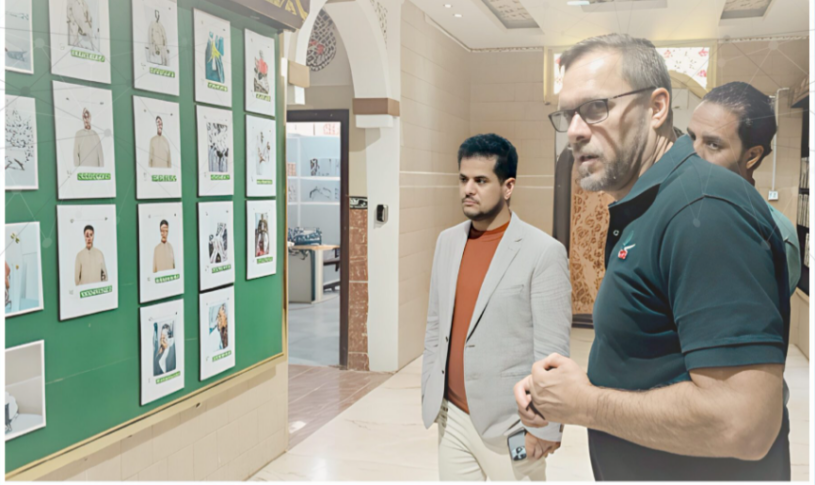
The delegation was received by the project’s Operations Director, Tony Roberts, and Deputy Administrative and Logistics Director, Ahmed Bakhit. They presented a detailed overview of Masam’s field operations, supported by photographs, highlighting the challenges and risks faced by its engineering teams. According to the presentation, 32 project personnel, including five foreign experts, have lost their lives while carrying out humanitarian demining operations. The presentation also documented civilian mine casualties and the different types of mines and explosive devices found across affected areas.
Project officials explained that Masam has been operating in Yemen since 2018 through 33 field teams deployed across several governorates. These teams have cleared nearly 58 million square meters of land and removed hundreds of thousands of mines and other explosive remnants of war. The project has also worked to build the capacity of Yemeni personnel and conduct ongoing community awareness activities.
During the meeting, the Director of the Mokha Center presented the Center’s research and advisory programs and its publications on peace and development, aimed at supporting policymakers and researchers. The two sides also discussed opportunities for cooperation in research, documentation, and archiving Masam’s humanitarian experience.
Jarallah stressed the importance of continuing demining efforts even after the war ends, particularly given the absence of accurate maps showing where mines were planted and the extensive scale of contamination across the country.
Future Challenges Facing Demining Efforts
Project Masam, launched by the King Salman Humanitarian Aid and Relief Centre (KSrelief) in 2018, is one of the leading humanitarian initiatives working to clear landmines, unexploded ordnance, and improvised explosive devices from affected areas in Yemen. The project operates through specialized engineering teams in cooperation with trained Yemeni personnel and in accordance with international mine action standards. Its activities include field surveys, identifying contaminated areas, clearing roads, residential areas, and agricultural land, as well as training national personnel and raising public awareness of the risks posed by mines and unexploded ordnance.

The project has achieved significant results on the ground, clearing more than 83 million square meters of land and returning it to safe use. It has also removed and dismantled more than 575,000 mines, unexploded ordnance, and improvised explosive devices. These include more than 407,000 items of unexploded ordnance, around 152,000 anti-tank mines, more than 7,500 anti-personnel mines, and over 8,500 improvised explosive devices.
Despite these achievements, demining operations continue to face major challenges due to the extensive scale of contamination and the continued discovery of new minefields and explosive remnants of war across several governorates. This highlights the need to sustain clearance operations, strengthen risk-awareness programs, and build national capacity to protect civilians, facilitate the safe return of displaced populations, and support recovery and reconstruction efforts.
Interview with the Director of Project Masam

To better understand the landmine problem in Yemen and the efforts being made to address it, the Mokha Center for Strategic Studies conducted an interview with Osama Al-Gosaibi, Director General of Project Masam for Landmine Clearance in Yemen.
The interview draws on Masam’s field experience and looks at the security and operational dimensions of mine-laying in Yemen, the impact on residential areas and major roads, and the challenges facing clearance teams. It also discusses the use of databases to identify high-risk areas, the problem of re-mining, the need for flexible field responses, and the conditions required for civilians to return safely.
The interview also examines how Masam identifies areas most likely to be mined, recurring patterns in Houthi mine-laying practices, and differences in how mines are planted across governorates. It addresses the absence of reliable minefield maps and the way Masam develops its own field-based mapping. It concludes with the main requirements for reducing casualties and recommendations for government authorities and local communities.
Has the experience accumulated by Project Masam’s teams over the past years helped accelerate the clearance of liberated areas and provide a clearer understanding of Houthi mine-laying patterns?
Absolutely. Since Masam began operations in mid-2018, our teams have built extensive technical and field experience. By the end of July 2026, the project had cleared more than 83.7 million square meters of land across Yemen. Working across such a large area has helped us better understand mine-laying patterns and methods.
So far, our teams have removed 578,226 mines, items of unexploded ordnance, and improvised explosive devices. This experience has helped us work faster and more efficiently. In July 2026 alone, our teams removed 7,101 mines and items of unexploded ordnance.
On average, how long does it take to secure a residential area or major road after military operations have ended?
It is difficult to give one timeframe for every area. Each location is different in terms of terrain, the number of mines, and the nature of the contamination. But residential areas and major roads are always a priority for us.
To give an idea of our current capacity, our field teams cleared around 1.6 million square meters in July 2026 alone. We continue to reduce clearance time by deploying teams where they are needed most, so civilians can return to normal life and important roads can reopen as quickly as possible.
Have databases and field experience improved your ability to anticipate where mines are likely to be found?
Yes. The databases we build and update every day are one of our most important tools. They record the locations and distribution of 409,726 items of unexploded ordnance, 152,285 anti-tank mines, 7,604 anti-personnel mines, and 8,611 improvised explosive devices already found by our teams.
These records act as living maps. They help us identify patterns, understand where the risks are higher, and direct our teams more effectively. The more data we collect, the better we are able to anticipate danger and respond to it.
Do you encounter cases where previously cleared areas are mined again? How common is this, and how does it affect your response plans?
Yes. This is one of the major challenges we face, especially in areas where control has changed more than once. We have cleared areas that were later retaken by the Houthi militias and then mined again before they withdrew. In those cases, our teams have had to return and start clearance work again.
It is difficult to give an exact number of re-mining cases because the problem is ongoing. We have recently seen examples in northern Hajjah, which shows that the danger can return even to areas that were previously considered safe.
This means our response plans have to remain flexible. In some cases, we have to resurvey areas that were already cleared to make sure no new mines or explosive devices have been planted.
What are the main requirements for ensuring the safe return of civilians after hostilities end?
The most important requirement is full clearance, not partial clearance. Civilians cannot return safely if even one mine remains buried in a road, a farm, or near a home.
The incident in Hayran District in Hajjah Governorate, where one young man was killed and another lost a leg while returning from their farm, is a painful reminder that farms and grazing areas need to be cleared just as much as residential areas.
Safe return also requires close cooperation between demining teams and local communities. People should not enter affected areas until Masam’s teams have confirmed that they are safe.
Is it possible to predict which areas are most likely to have been mined?
Based on our field experience, mines are often concentrated in places that people depend on and cannot easily avoid, such as key roads and pathways, agricultural land, and water sources.
We focus our surveys on these areas because mines planted there can stop people from moving, working, farming, or accessing water. These locations therefore receive particular attention from our field teams.
Is there a recognizable or recurring pattern in the way the Houthis deploy landmines?
The figures speak for themselves. The presence of 409,726 items of unexploded ordnance, more than 150,000 anti-tank mines, and thousands of anti-personnel mines and improvised explosive devices shows the scale and variety of the threat.
One clear pattern is the wide and often indiscriminate distribution of mines, along with the careful concealment of improvised explosive devices. Our teams have removed 8,611 such devices, some disguised to look like ordinary objects. This makes them especially dangerous to civilians who may not realize what they are.
Do Houthi mine-laying methods differ from one governorate to another?
Yes. The terrain affects both the type of mines used and the way they are planted. Methods used in mountainous areas differ from those used in coastal or agricultural areas such as Hajjah and Marib.
At Masam, we take these differences into account when deploying and equipping our teams. We also issue regular reports that track developments across the governorates, helping us adapt our work to the conditions in each area.
Given the absence of minefield maps, how do you approach clearance operations?
Since we are not provided with minefield maps, we build our own maps from field data. We rely on technical and non-technical surveys, as well as rapid responses to reports from affected communities.
Our teams survey the land systematically and document every mine and explosive device they remove. Over time, this allows us to build a detailed geographic database that helps guide clearance work even in the absence of official minefield maps.
What are the main requirements for reducing casualties caused by landmines?
Reducing casualties requires two things to happen at the same time.
First, large-scale clearance operations must continue and receive support. By the end of July 2026, Project Masam had cleared a total of 83,731,831 square meters of land.
Second, community awareness campaigns need to be expanded so people know how to recognize suspicious objects and avoid dangerous areas. Awareness is the first line of defense before our teams reach the site and remove the threat.
What are your main recommendations for civilian and government authorities, as well as local communities?
My message to local communities is simple: your lives are more valuable than anything else. Do not enter suspicious areas or farms that have not been inspected and cleared.
To the relevant authorities, we appreciate the cooperation that already exists, but we need even closer coordination to help field teams move more easily and to expand awareness campaigns.
Our goal at Masam is to achieve “A Life Without Landmines” in Yemen. That goal can only be reached through cooperation. The large number of mines and explosive remnants already removed shows how much work has been done, but also how much remains to be done.
Conclusion

Field evidence and available data show that landmines and explosive remnants of war in Yemen represent a humanitarian and development challenge that will extend beyond the conflict itself, particularly given the widespread contamination and the absence of accurate maps identifying mined areas.
Project Masam’s work—from field surveys and clearance operations to developing field-based maps, training national personnel, and raising community awareness—has played a central role in protecting civilians and helping communities resume essential activities. Despite significant progress, including the clearance of millions of square meters of land and the removal of hundreds of thousands of mines and explosive remnants, the scale of contamination remains substantial.
Addressing this challenge will require sustained research and field partnerships, continued support for demining teams, and the capacity to respond to the re-mining of previously cleared areas. These efforts will be essential to creating safer conditions for the sustainable return of displaced communities and supporting Yemen’s longer-term recovery and reconstruction.
