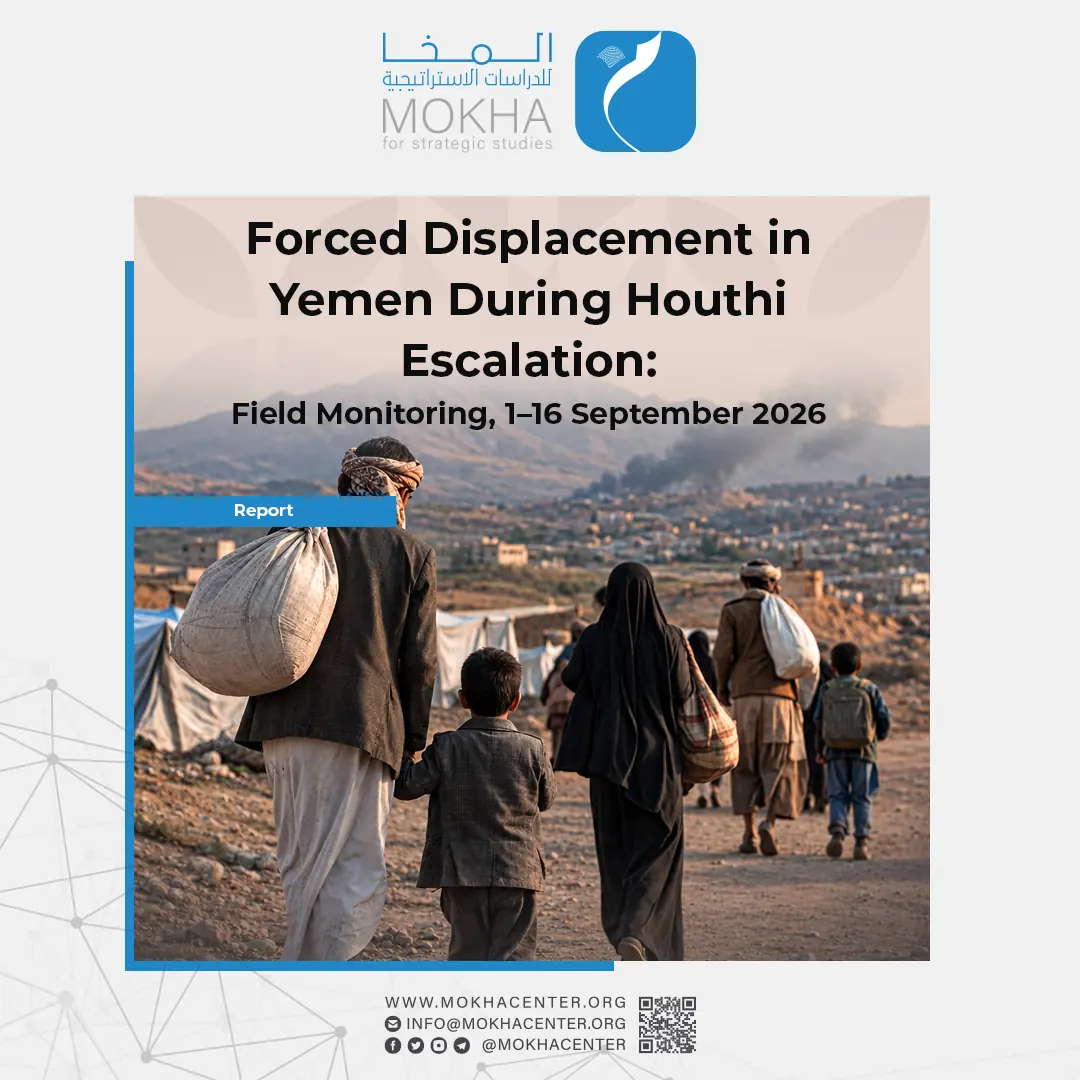
Forced Displacement in Yemen During Houthi Escalation: Field Monitoring, 1–16 September 2026
Introduction:
Yemen’s political and security environment underwent a sharp shift in September 2026, marked by the breakdown of the relative calm that had prevailed since the UN-sponsored truce of 2022. The renewed escalation of military operations, ground clashes, and intensive shelling between government forces and the Houthi group across the western coast, Taiz, Hodeidah, Marib, and Al-Jawf reactivated several key frontlines. These developments carry significant geostrategic implications, particularly given the concentration of hostilities along the western coast and the coastal belt surrounding the Bab al-Mandab Strait, as well as the seizure of strategic locations including Mokha, Dhubab, and Mayyun (Perim) Island. The resulting shifts have disrupted key access routes, further constrained Taiz’s western connections, and generated security and humanitarian repercussions extending beyond Yemen’s borders toward the Horn of Africa.
The conflict’s shift into a phase of open confrontation triggered a sudden wave of large-scale forced displacement, marked by both its speed and scale. Field data documented in the consolidated report issued by the Executive Unit for the Management of IDP Camps, under the Prime Minister’s Office, and updated through 16 September 2026, record the displacement of 19,417 families, comprising 131,761 individuals, across eight Yemeni governorates: Taiz, Lahj, Aden, Hodeidah, Abyan, Hadramawt, Al-Mahrah, and Shabwa.
These official figures are further supported by assessments from United Nations agencies and international organizations. Analysis of these displacement patterns indicates that thousands of families previously living in temporary displacement sites along the western coast and in Taiz were once again forced to evacuate and flee, in some cases for the second or third time. Repeated displacement has severely depleted the coping capacity of already highly vulnerable households. The population impact has also extended beyond Yemen’s borders, with refugees undertaking hazardous sea crossings across the Red Sea and Bab al-Mandab Strait toward the Obock region of Djibouti, resulting in a sudden increase in arrivals relative to the existing population of the town of Obock.
The sudden displacement has further worsened humanitarian conditions for affected Yemeni families. Many were forced to flee without their belongings, productive assets, or livestock, leaving them heavily dependent on emergency assistance to meet their most basic needs.
Across key social sectors, the crisis has placed additional strain on already fragile services. Dozens of educational facilities have been converted into emergency shelters for displaced families just as the new academic year begins. Health services have also been disrupted by shelling and interruptions to the delivery of essential supplies, while protection risks continue to rise for women, children, older persons, persons with disabilities, and people living with chronic illnesses.
This deterioration comes at a time when the international humanitarian response in Yemen is facing an acute and unprecedented funding shortfall. The funding gap is compounded by security and logistical constraints, shortages of relief supplies, and disruptions to transport links between ports and major urban centers, including the Aden–Mokha road. Together, these constraints are limiting the ability of humanitarian agencies to mount a rapid and comprehensive response.
General Context of the Displacement Wave
The resumption of hostilities by Houthi forces has turned large areas of western Yemen into high-risk zones. Monitoring reports indicate continued fighting along the western Taiz and southern Hodeidah fronts, accompanied by displacement movements through Jabal Habashi, Al-Ma’afer, Al-Shamayatayn, Al-Mudhaffar, Mokha, and Al-Khawkhah. These areas serve both as transit points for displaced populations and, in some cases, as places where newly displaced families eventually settle. This pattern indicates that displacement movements have shifted in response to changing levels of risk and the opening or closure of access routes.
The most significant consequence has been the transfer of pressure from areas of direct conflict to receiving communities. Areas hosting displaced populations, particularly in Taiz, Lahj, Aden, and Abyan, already face weak public services and declining purchasing power. Each new wave of displacement therefore increases demand for water, healthcare, food, shelter, and education in areas where resources are already limited.
Repeated Displacement and Loss of Assets
Testimonies and humanitarian assessments indicate that many families were forced to flee without sufficient time to take their belongings, livestock, or work equipment with them. This often pushes already vulnerable households into a state of acute insecurity, as they lose their sources of income, shelter, and local support networks at the same time. The impact is particularly severe for families that had already been displaced, as a second or third displacement further erodes their remaining savings, social ties, and ability to cope.
The consequences of repeated displacement go beyond the physical act of moving from one place to another. Each new displacement further weakens a household’s ability to withstand future shocks. Families may be forced to abandon what remains of their essential belongings and lose the support networks they had built in areas of temporary settlement. Over time, repeated displacement can leave households increasingly dependent on emergency humanitarian assistance, while reducing their prospects of rebuilding stable and sustainable livelihoods.
Regional Dimension
The crisis has also taken on a cross-border dimension. Between 10 and 16 September 2026, 2,776 people arrived in the Obock region on Djibouti’s northern coast. According to the latest available update, most of the new arrivals were women and children. Medical teams also recorded four births within a 48-hour period and identified two additional pregnant women in need of care. These cases highlight both the dangers of the sea journey and the specific humanitarian and protection needs associated with such movements.
This does not suggest that sea crossings have become the main route of displacement. It does, however, show how the crisis could extend beyond Yemen’s borders, shifting from an internal displacement emergency to one that places additional pressure on neighboring host communities and local services. The United Nations Population Fund has warned that the arrival of new displaced populations in Obock could place demands on a small host community beyond its existing capacity to absorb them.
Scale and Geographic Patterns of Displacement
The government report, updated through 16 September, provides the most detailed geographic breakdown available, documenting 19,417 families and 131,761 individuals across 51 districts in eight governorates. Taiz recorded the highest number, with 10,129 families and 70,957 individuals, followed by Lahj with 4,809 families and 33,663 individuals. Hodeidah recorded 1,471 families, Abyan 1,187 families, and Aden 1,622 families, while smaller numbers were distributed across Hadramawt, Al-Mahrah, and Shabwa.
OCHA figures provide a different temporal snapshot. Between the escalation of hostilities on 3 September and 9 September, OCHA recorded 11,442 newly displaced families nationwide, while explicitly noting that the figures were preliminary and may include some duplication. OCHA also reported that at least 908 families had already been displaced prior to the latest escalation and were forced to flee again from existing displacement sites. The difference between these figures can be partly explained by the longer reporting period covered by the subsequent government report, differences in verification scope and methodology, and the possibility that some databases do not include families living outside formally recognized displacement sites.
United Nations reporting places these figures within a broader, cumulative picture of displacement in Yemen. At the beginning of 2026, UN estimates put the total number of internally displaced people nationwide at approximately 4.8 million.
A more recent estimate appeared in a September 2026 study by the Mokha Center for Strategic Studies on the reproduction of vulnerability in Yemen amid protracted conflict. Drawing on data from the United Nations Office for the Coordination of Humanitarian Affairs (OCHA) in Yemen, the study estimated that the number of internally displaced people had reached approximately 5.2 million by March 2026. This figure reflects the cumulative effect of successive waves of displacement over the course of the conflict and should not be interpreted as the result of the September escalation alone.
Displacement Routes
The first route extends from the western coast and southern Hodeidah toward Taiz and Lahj. Hays, Al-Khawkhah, and Mokha emerge as key points of departure or transit, while Al-Ma’afer, Al-Shamayatayn, and Jabal Habashi in Taiz, along with Al-Mudarabah wa Ras Al-Arah and Tuban in Lahj, receive the largest share of displaced people. This route combines relative proximity to the fighting with the presence of social ties and road access that allow for temporary movement to comparatively safer areas.
The second route extends southward toward Aden and Abyan. Al-Buraiqah and Dar saad in Aden, as well as Khanfar and Zinjibar in Abyan, appear as important receiving areas. This route is characterized by a high degree of reliance on host families and self-settled sites, which reduces the accuracy of monitoring and makes needs less visible in camp-based statistics.
The third route extends eastward toward Hadramawt, Al-Mahrah, and Shabwa. Although the numbers moving along this route remain lower than those recorded along the first two routes, it remains significant because it reflects families’ search for deeper safety and the extension of displacement into eastern and border governorates. These areas may also require different monitoring mechanisms because of the dispersed nature of settlements, the small size of sites, and the high cost of access.
Spatial Distribution of Displaced Populations
| Governorate | Families | Individuals | Percentage |
| Taiz | 10,129 | 70,957 | 53.84% |
| Lahj | 4,809 | 33,663 | 25.54% |
| Hodeidah | 1,471 | 10,297 | 7.81% |
| Abyan | 1,187 | 8,309 | 6.30% |
| Aden | 1,622 | 7,162 | 5.43% |
| Hadramawt | 110 | 770 | 0.58% |
| Al-Mahrah | 70 | 490 | 0.37% |
| Shabwa | 19 | 113 | 0.10% |
| Total | 19,417 | 131,761 | 100% |
The table shows a strong concentration of displacement in Taiz and Lahj. This concentration suggests that humanitarian pressure could escalate rapidly if fighting continues along the western coast, particularly because the main receiving areas themselves lie close to escalation routes or depend on already damaged infrastructure.
Reception Areas and Conditions of Displaced Families
Displaced families are accommodated in three main ways: staying with host families, settling in existing displacement camps, or living in informal settlements, unfinished buildings, or in the open. The first and third categories are particularly difficult to measure accurately because they are not always captured by monitoring systems focused on formal displacement sites. OCHA has confirmed that many families arriving in southern areas have stayed with host communities or settled independently in locations outside routine monitoring systems.
Staying with host families provides displaced households with a degree of social protection, but it also shifts part of the burden of displacement onto the hosting household. When such arrangements continue for extended periods, they can place growing pressure on food, household income, and living space, while increasing the risk of social tensions, particularly in areas already affected by high prices and weak public services.
Basic Needs
Shelter represents one of the clearest gaps in the available response data. Shelter partners provided assistance to only 147 families, against a planned target of 11,000 families. This not only points to the large number of households whose shelter needs remain unmet, but also highlights the limited capacity of the humanitarian response to translate field assessments into timely assistance.
The shelter gap is closely linked to water, sanitation, and hygiene needs. Informal settlements and families living in the open typically lack adequate sanitation facilities, reliable water supplies, and waste management services. These conditions increase the risk of waterborne diseases and create additional protection concerns for women and children, who require safe and private facilities.
In terms of food security, confirmed assistance reached only 1,554 of the 6,144 families identified as having urgent needs, leaving 4,390 families without confirmed assistance. This gap poses an even greater risk to households that have lost their sources of income and productive assets, as well as to children, pregnant women, and people living with chronic illnesses.
Most Vulnerable Groups
Displacement has had a disproportionate impact on children. UNICEF reported that more than 57,000 children were among over 104,000 people displaced within a two-week period, according to its estimates. Schooling was also suspended or disrupted in 243 schools, including facilities that had been converted into temporary shelters. The consequences extend beyond the immediate loss of education: prolonged absence from school increases the risk of dropout, child labor, early marriage, and exploitation.
Women and girls face additional risks linked to the lack of privacy, gender-based violence, and declining access to reproductive health services. In Djibouti, the childbirth cases recorded among newly arrived refugees, noted earlier in this report, highlight the urgent need for sustained maternal and obstetric care rather than short-term emergency interventions alone.
Older people, persons with disabilities, and people with chronic illnesses become particularly vulnerable when families lose access to transport, medication, and support networks. Humanitarian prioritization should therefore not be based solely on household size, but should also take into account disability, pregnancy, illness, age, and separation from caregivers.
Humanitarian, Economic, and Social Impact of Displacement
Data contained in Report No. 3 issued by the World Health Organization and the Health Cluster on the current escalation in Yemen indicate a cumulative total of 2,883 casualties, including 2,379 injuries and 504 deaths. OCHA, meanwhile, had verified 14 civilian casualties across eight incidents as of 9 September, while additional incidents remained under verification.
This distinction is important because the cumulative health-sector figure serves a different purpose from the number of civilian casualties verified in specific incidents. The former may cover a broader geographic area and reporting period and may include injuries associated with military operations, while the latter refers specifically to documented civilian cases that have undergone defined verification procedures.
Education Under the Strain of War
The use of schools as emergency shelters creates a difficult trade-off between the immediate need for shelter and the longer-term right to education. Under the current circumstances, 243 schools and 137,000 students have been affected, according to the original source material. The consequences are particularly serious given that Yemen’s education system was already under considerable strain before the latest escalation. Returning children to school requires more than simply reopening buildings; it also depends on clearing unexploded ordnance and other hazards, repairing damaged facilities, and ensuring the availability of teachers and learning materials.
From a public policy perspective, continuity of education should be treated as an integral part of the humanitarian response rather than as a later stage of recovery. The longer schools remain in use as shelters, the more difficult and costly it becomes to return displaced children to education, and the wider the gap may grow between displaced students and their peers in host communities.
Health Services and Supply Chains
The original source material reported that 26 health facilities had ceased functioning and that seven health facilities or health assets had been damaged. While these figures should be directly cross-checked against the original health-sector report before final publication, the broader trend is consistent with OCHA reporting on restrictions on movement and access, as well as disruptions to essential supplies. The impact extends beyond physical damage to facilities and affects fuel, blood supplies, anesthesia, transportation, and referral capacity.
The effects are particularly severe in displacement areas, where demand for healthcare rises at the same time that operational capacity declines. Safe childbirth, trauma care, treatment for malnourished children, and services for people with chronic illnesses therefore become direct tests of the health system’s ability to withstand the pressures created by the crisis.
Humanitarian and Institutional Response
The Executive Unit for the Management of IDP Camps established operations rooms and monitoring teams at both governorate and district levels and issued an urgent appeal prioritizing shelter, food, water and sanitation, rapid response, and health services. The Ministry of Health also introduced a short-term emergency package that included ambulances, medical supplies, and support for blood banks and surgical hospitals, according to the source material.
The value of these mechanisms lies in their ability to generate a rapid picture of conditions on the ground and connect identified needs with humanitarian actors. Their effectiveness, however, remains dependent on adequate funding, freedom of movement, harmonized definitions and databases, and the inclusion of families living outside formal displacement sites.
International Response and Sectoral Gaps
| Response Area | Assistance Delivered | Identified Gap |
| Rapid Response Mechanism | 2,723 families out of 4,116 verified families | 2,127 awaiting assistance |
| Food Security | 1,554 families out of 6,144 | 4,390 families without confirmed assistance |
| Shelter | 147 families out of a target of 11,000 | Gap affecting more than 98% of the target population |
| Multipurpose Cash Assistance | 1,381 families | Coverage needs to be expanded, particularly among host families |
| Water, Sanitation and Hygiene (WASH) | According to OCHA, no deliveries were recorded in the latest update | Critical gap in newly established displacement sites |
These figures indicate that the main challenge lies in the mismatch between the scale and speed of displacement and the pace and reach of the response. The most severe gaps are in shelter and WASH—two sectors in which delays can expose displaced populations to immediate health and protection risks.
Funding and Operational Constraints
The original source material states that Yemen’s 2026 Humanitarian Response Plan, valued at 2.16billion,hadreceivedonly20%oftherequiredfunding-437.9 million—as of mid-September. This figure should be supported in the final version by an official and verifiable funding update. Within the context of the report, however, it points to a substantial gap between humanitarian requirements and the resources available to meet them.
Financial constraints are compounded by restrictions on humanitarian movement. OCHA reported temporary suspensions of movement between Mokha, Al-Khawkhah, and Hays, as well as between Aden and Mokha, while movement permits were not issued on 9 September. When humanitarian access is interrupted, the consequences extend beyond delayed aid delivery: household verification is also delayed, data quality deteriorates, and the gap between recorded needs and actual needs on the ground widens.
Analytical Assessment and Outlook
The crisis suggests that displacement is no longer simply a consequence of the fighting, but is increasingly reshaping the political and social geography of the conflict. The concentration of displaced populations in Taiz and Lahj, growing pressure on Aden and Abyan, and the emergence of a maritime route toward Djibouti together create stronger links between frontline security, urban stability, maritime access, and broader regional pressures.
This does not mean that international shipping will necessarily be disrupted or that a large-scale refugee movement is inevitable. A more measured assessment is that continued fighting near coastal corridors increases the risk of disruption to humanitarian and commercial transport, raises the cost of the response, and makes access to affected civilians more difficult.
Possible Displacement Trajectories
- Expansion of the fighting. If hostilities spread to additional fronts, further waves of displacement could follow, while some current reception areas could themselves become sources of new displacement. This would increase secondary displacement and place additional pressure on services in Taiz, Lahj, Aden, and Abyan. This is a conditional analytical scenario rather than a quantified forecast.
- Prolonged military stalemate. Major territorial movements could subside without a political settlement, leaving frontlines largely frozen while displaced populations remain in protracted displacement. The report assesses this as carrying particularly serious long-term humanitarian consequences, as emergency assistance risks becoming a source of prolonged dependence while schools, public facilities, and essential services remain under sustained pressure.
- A verifiable de-escalation. A halt to hostilities, reopening of roads, easier movement permits, and more flexible funding could help contain further displacement and allow essential services to begin recovering. De-escalation would not, however, result in an immediate or comprehensive return. Safe return would require the removal of security risks, restoration of housing and livelihoods, and sufficient assurances that renewed fighting would not force families to flee again.
Conclusion
Available evidence points to a large-scale and multidimensional displacement crisis in Yemen during September 2026. Government data recorded 19,417 displaced families—131,761 individuals—across eight governorates as of 16 September. UN and international assessments, however, indicate that displacement was rapid and fluid, with some families remaining outside routine monitoring systems. The largest concentrations were recorded in Taiz and Lahj, with further displacement into Aden, Abyan, and the eastern governorates, alongside the emergence of a maritime refugee route to Djibouti.
The severity of the crisis lies in the convergence of four pressures: the proximity of major reception areas to active frontlines, repeated displacement and the loss of household assets, mounting pressure on education, health, and water services, and a widening gap between humanitarian needs and available funding. Without a response that combines civilian protection, improved humanitarian access, support for host communities, and the restoration of essential services, there is a growing risk that what began as emergency displacement will become prolonged and increasingly difficult to reverse.
