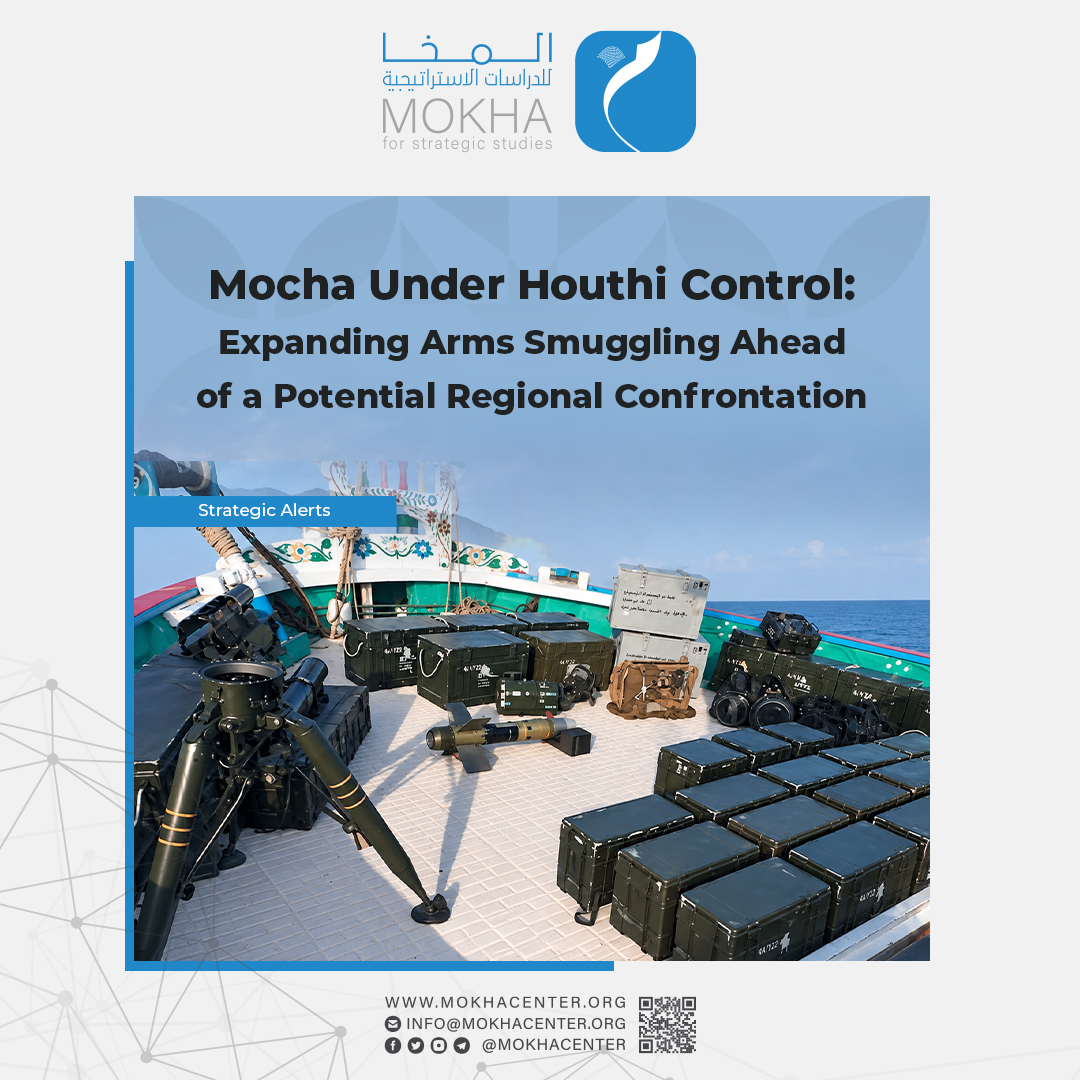
Mocha Under Houthi Control: Expanding Arms Smuggling Ahead of a Potential Regional Confrontation
Context
The Houthis’ takeover of the city and port of Mocha, the coastal strip extending toward Bab al-Mandab, and the Hanish Islands marks a significant shift in the security landscape. Its significance goes beyond territorial expansion: it changes the geography available to Houthi military supply networks, particularly those used to move Iranian weapons and military components into Yemen.
The new territorial configuration gives the Houthis a more continuous coastal presence stretching from Hodeidah toward Bab al-Mandab. This broadens the range of locations available for unloading, transport, storage, and redistribution, while giving Iran-linked smuggling networks greater flexibility to shift landing points and transit routes. A wider and more dispersed coastal network would make surveillance and interdiction considerably more difficult.
The geography of the area compounds the challenge. Ports, islands, small harbors, coastal zones, and the rugged western highlands of Taiz provide multiple options for dispersing storage sites and military assets. Shipments could be concealed, moved inland, or redistributed through routes that are harder to monitor and target.
| VESSEL TRACKING
Maritime-tracking data cited by Eekad and obtained by the Mokha Center shows that the cargo vessel MSV AL JUSUFI was off Mokha Port at 06:06 UTC on Thursday, September 10, 2026, after sailing from the Gulf through the Arabian Sea and the Gulf of Aden. |
There is currently no confirmed evidence linking the vessel to an arms-smuggling operation. Its movement, however, is notable in the current wartime context and following the latest changes on the ground. Vessel movements, ownership, routes, cargoes, and possible links to transport and smuggling networks therefore warrant closer scrutiny.
The expansion of Houthi control could also facilitate the movement of weapons and sensitive military components supplied by Iran, including missiles, drones, guidance systems, spare parts, and components required for their operation and development.
Control of Mocha does not necessarily mean the port will become a direct entry point for Iranian weapons. Its greater strategic value lies in the additional geographic and logistical options it gives Houthi supply networks. More landing points and transport routes would make those networks more flexible, more resilient, and harder to detect or disrupt.
A Regional Hub Beyond Yemen
The implications may also extend beyond supplying the Houthis themselves. The western coast and Mocha Port could emerge as a hub for the collection and redistribution of weapons and the transfer of military expertise to terrorist groups and transnational armed networks in the Horn of Africa, particularly in Somalia.
If smuggling networks expand alongside a wider range of maritime and coastal routes, the area could shift from being primarily a supply corridor for the Houthis into part of a broader regional network for the movement of weapons and military expertise. Such a development would have direct security implications for both sides of the Red Sea.
Rebuilding Military Capability
From this perspective, arms smuggling should be viewed as part of a broader effort to rebuild and strengthen Houthi military capabilities. The continued flow of advanced weapons and military components into Houthi-controlled areas, combined with the group’s expanding coastal presence, could point to an effort to build larger stockpiles and develop capabilities suited to a future phase of escalation.
This becomes particularly significant if the Houthis are preparing for a future regional confrontation alongside Iran, or as part of Tehran’s broader military and security calculations in the region. Under such a scenario, Houthi-controlled territory—especially coastal areas near Bab al-Mandab—could serve as a forward operating platform, supporting military operations through missiles and drones as well as maritime capabilities and technical components smuggled into and developed within Houthi-held areas. The Mokha Center has previously published in-depth analyses examining this possibility.
The implications extend beyond strengthening the Houthis’ own military capabilities. A coastal and mountainous environment better suited to receiving and concealing advanced weapons and military components could allow the group to maintain larger and more sophisticated missile and drone stockpiles and deploy them in support of wider regional objectives.
Risk of Regional Escalation
In the event of a regional confrontation, these capabilities could open an additional military front from the Red Sea, placing critical infrastructure and strategic interests across the region at risk while further threatening international shipping and trade routes. This would raise the cost of securing maritime corridors and increase the risk of a wider conflict.
The proliferation of supply routes, landing points, and storage sites would also make these capabilities more difficult to contain. It could give the Houthis greater capacity to replace weapons and components lost during military operations, potentially prolonging a confrontation and complicating regional efforts at deterrence and containment.
| MOKHA CENTER ASSESSMENT
The Mokha Center warns against limiting the response to intercepting arms shipments once they are already in transit. The priority should be to prevent the Houthis from establishing a durable military presence and supply infrastructure along the western coast and in the western highlands of Taiz. Entrenching their position in an area that combines maritime access with difficult mountainous terrain could turn it into a forward base for storing and deploying military capabilities, facilitating arms smuggling, and providing the group with operational depth directly connected to Bab al-Mandab. |