Survival Challenges: The Future of the Houthis Amid Current Developments
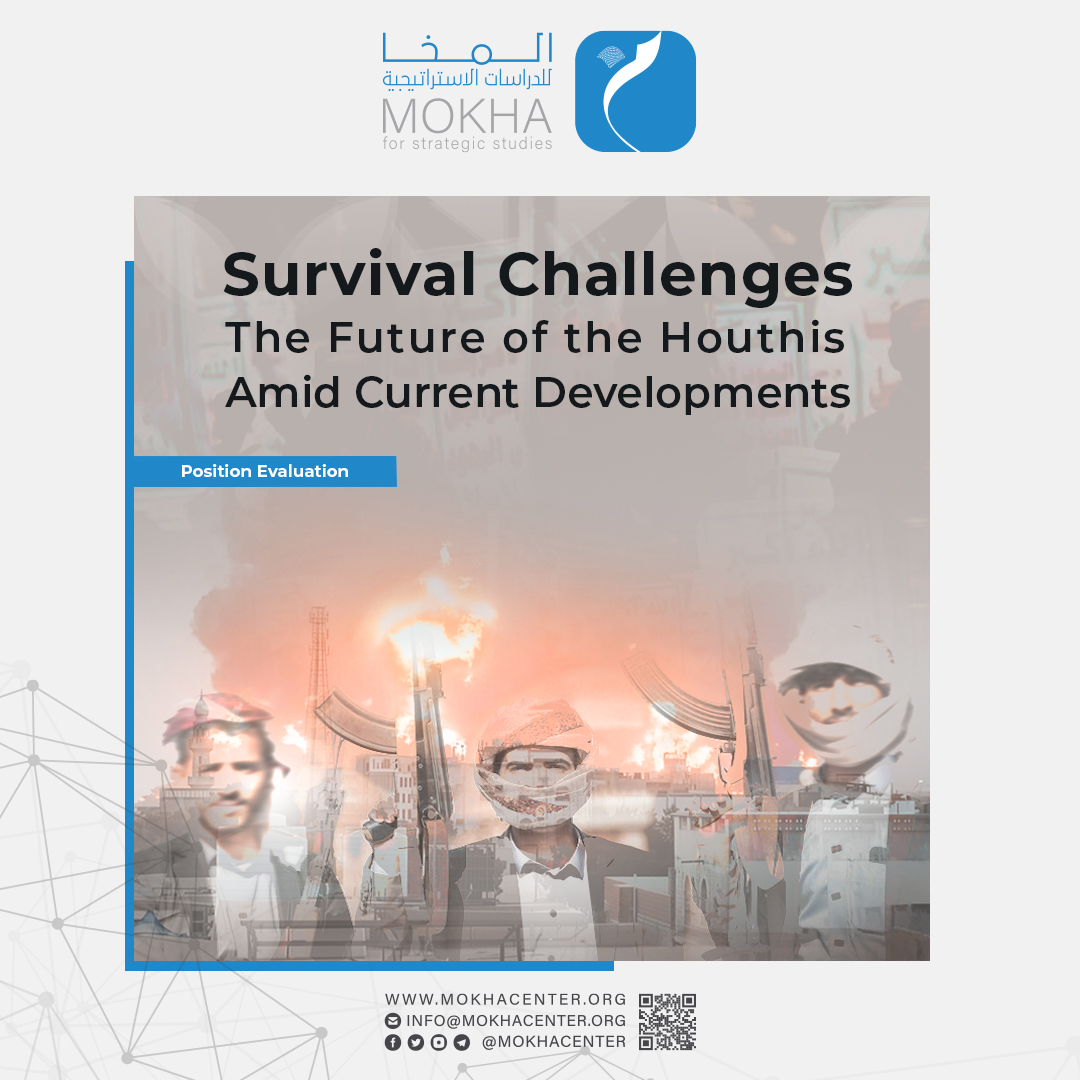
The current phase represents a pivotal turning point in the trajectory of the Houthi movement, placing it before existential possibilities for its future in the coming period. This is due to the interplay of internal factors, including signs of structural fragmentation, rising popular pressure, and the drying up of war resources, along with external factors linked to regional and international shifts and efforts to end Iran’s project in Yemen.
This paper analyzes the Houthis’ predicament amid developments in the local environment and changes in the external environment, and outlines potential scenarios for the group’s future, in the context of anticipating the path it may take in facing current challenges.
Internal Challenges: Isolation and Deteriorating Living Conditions
Service Collapse and Economic Pressure
Areas under Houthi control are experiencing severe service and living conditions, fueling rising public discontent and frustration. These difficulties are neither new nor sudden; since taking power, the Houthis have not established a governance model that effectively provides services or improves citizens’ quality of life.
What is new, however, is the increasing economic pressure on the group’s sources of support and funding, which have historically sustained their authority and war efforts. This pressure has manifested through several measures implemented by the legitimate government as part of broader economic reforms, including the centralization of banking control under the Central Bank in the temporary capital, Aden, oversight of financial transfers, and intensified efforts to intercept smuggling via land borders and maritime routes. Numerous shipments of weapons, drugs, and equipment have been seized as part of these operations.
Economic strain has been further compounded by the relocation of major international organizations—including most recently the UN Resident Coordinator’s office—from Sanaa to Aden, and the suspension of some humanitarian programs that the Houthis had previously exploited to strengthen their military position on the frontlines. This step followed a series of arrests carried out by the Houthis against UN and other international staff operating in Sanaa.
The combined effect of collapsing public services, restricted funding, and disrupted humanitarian programs has deepened the Houthis’ internal isolation and weakened their control over the territories under their authority.
Fracturing of Political and Functional Alliances
Since the assassination of the late President of the General People’s Congress (GPC), Ali Abdullah Saleh, by the Houthis, the group’s internal political alliances—upon which the partnership-based structure of the Supreme Political Council and the government was built—have gradually begun to unravel. This partnership had originally governed the rotation of governmental authority between the two sides.
By the end of 2023, the Houthis announced what they called a policy of “radical changes,” targeting the removal of GPC partners from key positions and replacing them with their own loyalists. These measures significantly undermined the alliance between the two factions, resulting in prolonged delays in forming a new government following the dismissal of the Bin Habtour cabinet for over a year.
The subsequent government, led by Ahmed Al-Rahwi, was destroyed in a targeted airstrike in August, which killed the Prime Minister and most cabinet members under complex and mysterious circumstances. This incident sparked suspicions about possible leaks of intelligence regarding the meeting location and raised questions about internal purges within the group itself.
Moreover, the breakdown of the functional partnership and the exclusion of public employees have created a form of “hidden unemployment”, as state institutions in Houthi-controlled Sanaa operate without meaningful activity. Employees attend work without performing real tasks and often without receiving regular salaries.
Recently, tensions between the Houthis and the GPC in Sanaa have intensified, evident in several manifestations: the arrest of GPC leaders, preventing party celebrations for its founding anniversary, the detention of the GPC Secretary-General (Sanaa wing), and the party’s announcement to suspend its political and organizational activities at the end of October. Collectively, these developments have further politically and socially isolated the Houthis within the areas they control.
Leadership Attrition and Signs of Structural Fragmentation
Recently, the Houthis have faced the loss of several key leaders due to targeted airstrikes by Israeli forces, which have focused on high-level political and military figures since July. These strikes included the Houthi government’s top officials in August, as well as critical military leaders whose deaths the group has acknowledged—such as Houthi Chief of Staff Muhammad Al-Ghamari—and others whose deaths are still reported through leaks, including Interior Minister Abdelkarim Al-Houthi and several field commanders in Al-Jawf and Marib.
This leadership attrition has disrupted the group’s operational management, leading to erratic security measures and reactive responses both domestically and externally. Externally, the Houthis have returned to issuing threatening rhetoric against Saudi Arabia and escalated military activities along the border, including two military drills in the past two weeks. Internally, the group has launched widespread arrest campaigns targeting political figures, activists, teachers, and ordinary citizens. Among those detained were the Secretary-General of the GPC allied with the Houthis in Sanaa (Ghazi Al-Ahwal), the Secretary-General of the Ba’ath Party (Rami Abdulwahab Mahmoud), and members of other political factions. These arbitrary arrests, especially in Sanaa, Ibb, and more recently Dhamar, reflect the internal confusion within the group and suggest a loss of direction in managing crises.
The Houthis’ response to leadership losses has also revealed signs of internal structural fragmentation. Arrests have extended beyond opponents to include military, security, and political leaders within the group’s own apparatus, the latest being the detention of the Political Council Secretary (Yasser Al-Houri) on charges of collaborating with external entities.
Additionally, the Houthis face pressure from defections within their military formations, some of which have been publicly announced. Notably, the Chief of Staff of the National Army received a Houthi brigade commander who defected to the National Army. Media outlets from the National Resistance and the Giants Brigades similarly reported receiving officers formerly loyal to the Houthis.
Politically, the group is struggling to maintain cohesion among its leadership, exemplified by statements made by Sultan Al-Sam’i, a senior figure from the Yemeni Socialist Party and member of the Houthis’ Supreme Political Council, who publicly criticized the group and its leadership, claiming that an unknown entity, rather than the group itself, controls affairs in Houthi-held areas.
Amid these internal crises, the recent escalation of anti-Saudi rhetoric and renewed war discourse appears to be a strategic attempt to distract from internal challenges and preserve the cohesion of its internal front.
Regional Context: Exposure of Iranian Support and Shifts in the Balance of Power
Declining Iranian Support
The fall of the Assad regime in Syria dealt a severe blow to Iran’s logistical infrastructure in the region. Syria had served as a strategic link in Iran’s chain of influence stretching from Tehran to Beirut and ultimately to Sanaa, providing training camps, communications networks, field experts, and media training.
This collapse deprived the Houthis of a critical logistical and training hub, significantly reducing gains in these strategic areas and also paralyzing Lebanese Hezbollah’s operational capacity. As a result, Iran and its regional proxies face difficult choices. Tehran appears to have opted for intensified support to the Houthis through alternative mechanisms to maintain its regional project. However, given the Houthis’ internal and external challenges, such support may be insufficient to restore balance to Iran’s regional influence; at best, it may serve to stimulate unrest and reinforce instability in Yemen and key international maritime routes.
Alternative Alliances
In an apparent effort to compensate for Iran’s reduced regional role, the Iranian Revolutionary Guard has expanded the Houthis’ regional alliance network, from Iraqi militias to Somalia’s Al-Shabab, and from enhanced smuggling networks in the Gulf of Aden to the Red Sea. The Houthis aim to build an alternative support structure that ensures financial and logistical continuity, mitigating the impact of the depletion of their traditional sources of power and resources.
Ceasefire in Gaza
The war in Gaza provided the Houthis with an opportunity to restore internal cohesion and advance Iran’s influence in the Red Sea under the cover of supporting Palestinian resistance. It also generated popular sympathy across the Arab and Islamic world and enabled mobilization of fighters to reinforce weakened domestic fronts under the pretext of preparing to fight the U.S. and Israel.
However, the Gaza ceasefire removed the Houthis’ justification for naval escalation and undermined their moral legitimacy for sustaining Iran’s project in the Red Sea. The halt of hostilities also reopens domestic pressures on the Houthis to provide public services and pay long-suspended salaries, which the group has failed to deliver. Their reliance on blaming “external aggression” or “major powers” as a pretext to avoid responsibilities has eroded credibility, leaving the Houthis in a dilemma that may only be resolved by inventing new pretexts, such as escalating internal conflict with the legitimate government or seeking a new external adversary.
Increasing International Pressure
The international community, led by the United States, views the Houthis as a persistent threat, not a temporary one. The U.S., Australia, Canada, and New Zealand have designated the Houthis as a foreign terrorist organization. This has led to intensified efforts to curb smuggling networks benefiting the group. The U.S. Treasury has placed dozens of organizations and individuals on sanction lists for supporting Iran’s proxies, including the Houthis. Multiple leaks also indicate a growing international intent to neutralize Houthi threats through a combined Yemeni/international deterrence strategy.
Collectively, the Houthis face multi-dimensional isolation—political, economic, and logistical—that could escalate into a decisive confrontation aimed at ending Iran’s project in Yemen.
Future Scenarios
The Houthis now face a critical dilemma in navigating internal and external challenges. Their upcoming choices will directly reflect their assessment of the current reality and their strategic vision for the next phase, while regional and international dynamics will indicate how external actors intend to engage with the Yemeni issue:
Scenario One: Military Escalation
This scenario assumes that the Houthis choose to enhance their regional role by leveraging the Palestinian issue as a tool to legitimize their local and regional position. They would continue escalating attacks against Western and Israeli interests and expand targeting of Gulf interests as a strategic alternative to strengthen their negotiating position. Iran could compensate for the decline in direct support by pushing the Houthis into alternative alliances, coordinating with Iraqi militias, Al-Shabab in Somalia, and other terrorist groups, while using the maritime security file as a strategic leverage point to extract political gains and reduce international pressure.
Domestically, the Houthis may escalate internal conflict by targeting non-loyal elements within their territories, resuming operations in Marib, Taiz, and potentially expanding to southern and eastern provinces such as Al-Dhale, Lahj, Shabwa, and Abyan. The goal would be to achieve territorial gains, consolidate internal cohesion, and divert attention from mounting internal crises.
In response, international and regional actors would likely pursue decisive military action to neutralize Houthi threats and end Iran’s project in Yemen, by supporting the Yemeni government and allied military forces, and forming an international coalition to secure key maritime routes.
Scenario Two: Ceasefire, Peace, and National Reconciliation
This scenario envisions the Houthis engaging in negotiated solutions, particularly regarding maritime security, to halt threats and limit their military capabilities. Internally, they would participate in restoring state authority, negotiating an end to their coup and arranging a power-sharing framework for the next phase.
Pressure for this scenario would come from political isolation, economic constraints, eroding domestic legitimacy, public discontent, diminishing Iranian support, and international sanctions, including their designation as a terrorist organization.
Given the Houthis’ previous failure to negotiate in good faith, serious indicators of commitment would be required, such as:
- Agreement to a mechanism ending their threats to maritime security
- Severing ties with Iran
- Abandoning de facto authority and fully engaging in negotiations with the legitimate government
- Releasing political detainees, UN employees, and Saudi prisoners
Scenario Three: Temporary Adaptive Flexibility
Here, the Houthis adopt a hybrid approach, maintaining limited regional influence through intermittent “resistance” rhetoric and threats to international navigation, while negotiating to reduce direct threats. Domestically, they maintain partial truces on internal fronts and encourage engagement in political dialogue with the UN envoy or local and regional actors, without committing to enforceable agreements.
Meanwhile, international and regional policies remain largely on hold, pending broader developments, such as the Gaza ceasefire or Iranian nuclear negotiations.
Key Factors Influencing the Most Likely Scenario
- Iranian Position
Iran’s stance is the primary factor influencing Houthi behavior. This depends on whether Tehran continues support and expands alliances or trades its support for economic or nuclear concessions. Successful international agreements on Iran’s nuclear program and economic relief could tilt the Houthis toward negotiation and peace, while insufficient progress may favor escalation. Key determinants are:
- The concessions Iran offers major powers economically and on the nuclear file
- The latitude allowed to Iran by these powers in exchange for concessions
- Outcomes of the Gaza Ceasefire
A successful Gaza ceasefire could motivate the U.S. and Israel to secure maritime routes in the Red Sea and eliminate Iran’s influence in Yemen, providing the Yemeni government and its allies with an opportunity to resolve the internal conflict that has persisted for over a decade. - Cohesion Among Legitimate Forces
Internal divisions within the Presidential Leadership Council and among the components of the legitimate camp can sustain Houthi control and obstruct military solutions. Achieving cohesion and unified command is essential for leveraging escalation to impose peace or negotiating from a position of strength. - Rising Popular Pressure
Intensifying domestic protests, public anger over deteriorating services, corruption, and repression increases the likelihood of escalatory Houthi actions. This gives the legitimate government the opportunity to capitalize on the militia’s popular isolation and erode the fear barrier within Houthi-controlled areas. - Internal Cohesion of the Houthis
Emerging divisions within Houthi factions are critical. Hardline elements favor escalation, while pragmatic factions prefer negotiation to minimize losses. The group’s choices depend on whether one faction can dominate or whether the Houthis develop a shared strategy acceptable to Saudi Arabia and the internationally recognized Yemeni government. - International Guarantees
In a peace scenario, the availability of international guarantees for Saudi Arabia, Gulf states, and the Yemeni government would ensure security against future Houthi threats, protect the legal position of the government, and secure a political future for the Houthis if they engage genuinely in peace. - Gulf Stance on the Houthi Project
The position of Gulf states, particularly Saudi Arabia, regarding the Houthis as a political component in any settlement—or as a weak de facto authority—affects potential outcomes. Riyadh’s general approach is gradual disengagement and mediation. The question remains whether it will leverage regional developments to reduce concessions and impose a new balance following Iran’s setbacks or accept the Houthis as a de facto actor despite the long-term costs, including implications for relations with local allies in Yemen.