Seminar Report: Yemen in Light of Regional and International Developments
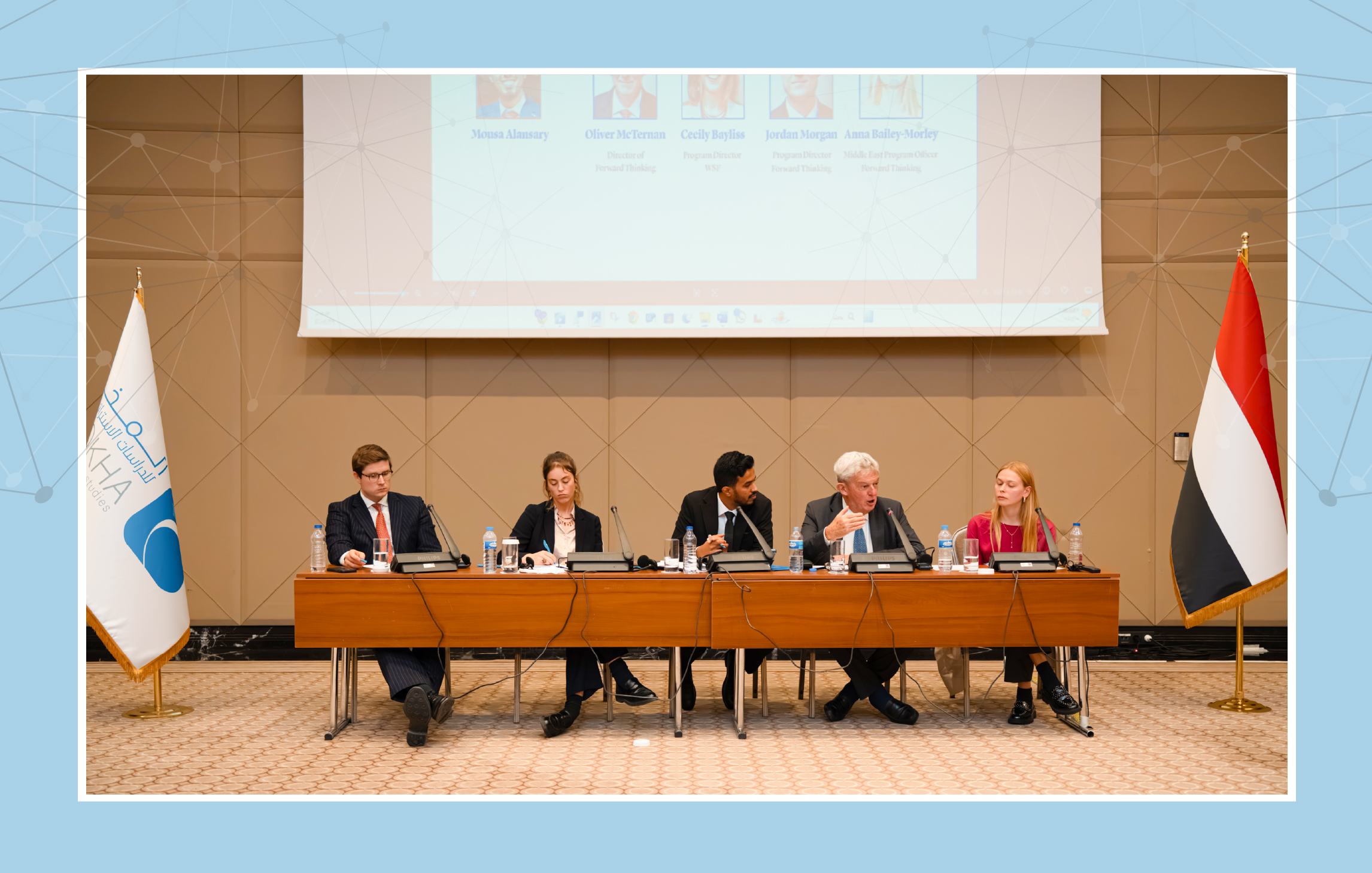
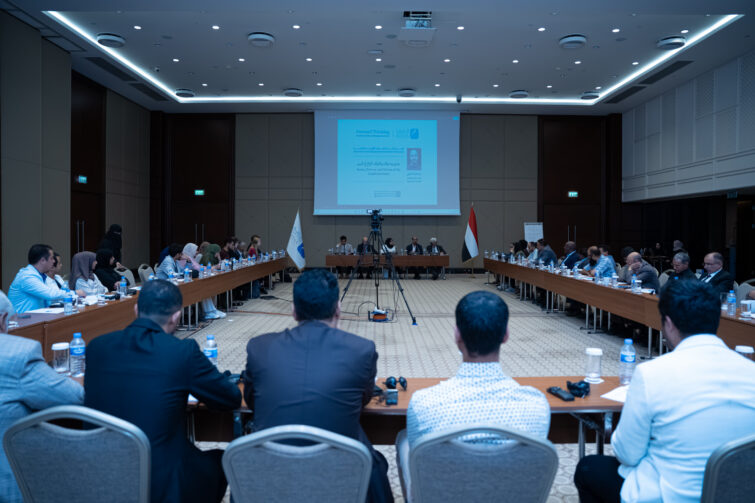
The Mokha Center for Strategic Studies and the Forward Thinking organization held a seminar titled Yemen in Light of Regional and International Developments.The event brought together Yemeni and British experts to analyze the drivers of the Yemeni conflict, examine regional and global dynamics, and explore pathways toward peace.
Experts taking part included Ateq Jarallah, Director of the Mokha Center; Oliver McTernan, Director of Forward Thinking; Ismail Al-Suhaili, Professor of Political Science and Senior Researcher at the Mokha Center; Ahmed Ramadan, Director General of the London Center for Media Strategies; Cecily Bayliss, Program Director at WFS; Anna Bailey Morley, Middle East Program Officer at Forward Thinking; and Jordan Morgan, Program Director at Forward Thinking.
Opening Presentation – Ismail Al-Suhaili
Al-Suhaili traced the roots of Yemen’s conflict to the historical dominance of the Imamate, which claimed divine right rather than deriving legitimacy from the will of the people. He explained how the Houthis capitalized on internal discontent, Iranian support, Hadi’s political maneuvering, and Saleh’s ambitions to carry out the September 21, 2014 coup and seize Sana’a.
He identified the key factors that continue to drive the conflict: Houthi authoritarian control, weak and fragmented legitimacy, Iranian interference, Saudi–UAE rivalry, international complacency, and competition over Yemen’s strategic location. Al-Suhaili stressed that peace in Yemen is both a national necessity and a regional and international opportunity—through restoring institutions, enabling democracy, and building a sovereign and capable state.
Analysis of Conflict Mechanisms – Oliver McTernan
McTernan provided an in-depth analysis of the conflict’s dynamics in Yemen and the wider region. He examined issues of loyalty, funding, recruitment, and command structures, highlighting the impact of external interventions on reshaping the threat landscape.
He cautioned that “peace through force” creates only fragile outcomes, stressing that sustainable peace must be rooted in justice, law, and dialogue. Drawing on lessons from South Africa and Ireland, he argued for inclusive approaches. McTernan also criticized Israel for repeated violations of international law and reliance on prolonged conflict, often with U.S. support.
Regional and Global Transformations – Ahmed Ramadan
Ramadan examined global power struggles and their implications for Yemen. He identified three overlapping conflicts: Russia versus the West (manifest in Ukraine), China versus the United States (with Russia benefiting), and Europe versus the United States (the most consequential, reshaping the global order).
He argued that these struggles are shifting Middle East balances and directly influencing Yemen. Despite its strategic location in trade, energy, and connectivity, Yemen remains excluded from global opportunities due to instability. Ramadan urged a transition from a “state of conflict” to a “state of partnership,” the only framework capable of accommodating Yemen’s diverse society.
Future Scenarios – Ateq Jarallah
Jarallah analyzed possible trajectories for Yemen, noting that the conflict has shifted from a domestic crisis to a regional and now international issue involving powers such as the U.S., the U.K., and Israel.
He outlined three scenarios:
- Direct Israeli intervention weakening but not defeating the Houthis.
- Restructuring legitimacy followed by escalated military action with regional support (the most likely).
- Continuation of the current attritional stalemate.
Women and the Humanitarian Dimension – Cecily Bayliss
Bayliss highlighted the disproportionate burden borne by women during the conflict, particularly in health and access to basic services. She identified water scarcity as a critical challenge, suggesting Gulf states finance Yemen’s water needs while European partners invest in sustainable management.
She underscored that women’s participation in political decision-making is essential for building a just and lasting peace.
Yemen’s Image in Western Media – Anna Bailey Morley
Morley examined how Yemen is portrayed in Western media, noting it is often reduced to a proxy battlefield between Saudi Arabia and Iran or between the United States and Iran, with the humanitarian dimension overlooked.
This lack of visibility, she argued, has left Yemen “invisible” to international public opinion. She called for amplifying Yemeni voices and local narratives to counter narrow geopolitical framings.
Leadership in Conflict – Jordan Morgan
Morgan reflected on Yemen’s declining priority on the international agenda amid other regional crises such as Gaza. He argued that platforms like this seminar help bring Yemen back into focus.
He warned against framing the conflict in religious or ideological terms, which deepen divisions and fuel violence. Instead, he called for strengthening civic and community leadership and reviving national dialogue as practical steps forward.
Key Takeaways
The seminar underscored that Yemen is no longer an isolated conflict but part of broader regional and international struggles. Participants agreed that force cannot deliver sustainable peace. Stability requires justice, national partnership, and a capable state that provides governance and development—allowing Yemen to leverage its strategic position rather than remain an arena of conflict.