
Mokha Center Launches Women Above the Ashes Documenting Yemeni Women’s Experiences of War
The Mokha Center for Strategic Studies launched Women Above the Ashes in Istanbul, a major documentation project capturing the lived experiences of Yemeni women after more than a decade of war. The book presents 100 testimonies collected from women across Yemen’s governorates, offering a detailed account of the social, economic, and humanitarian consequences of prolonged conflict on women and their families.
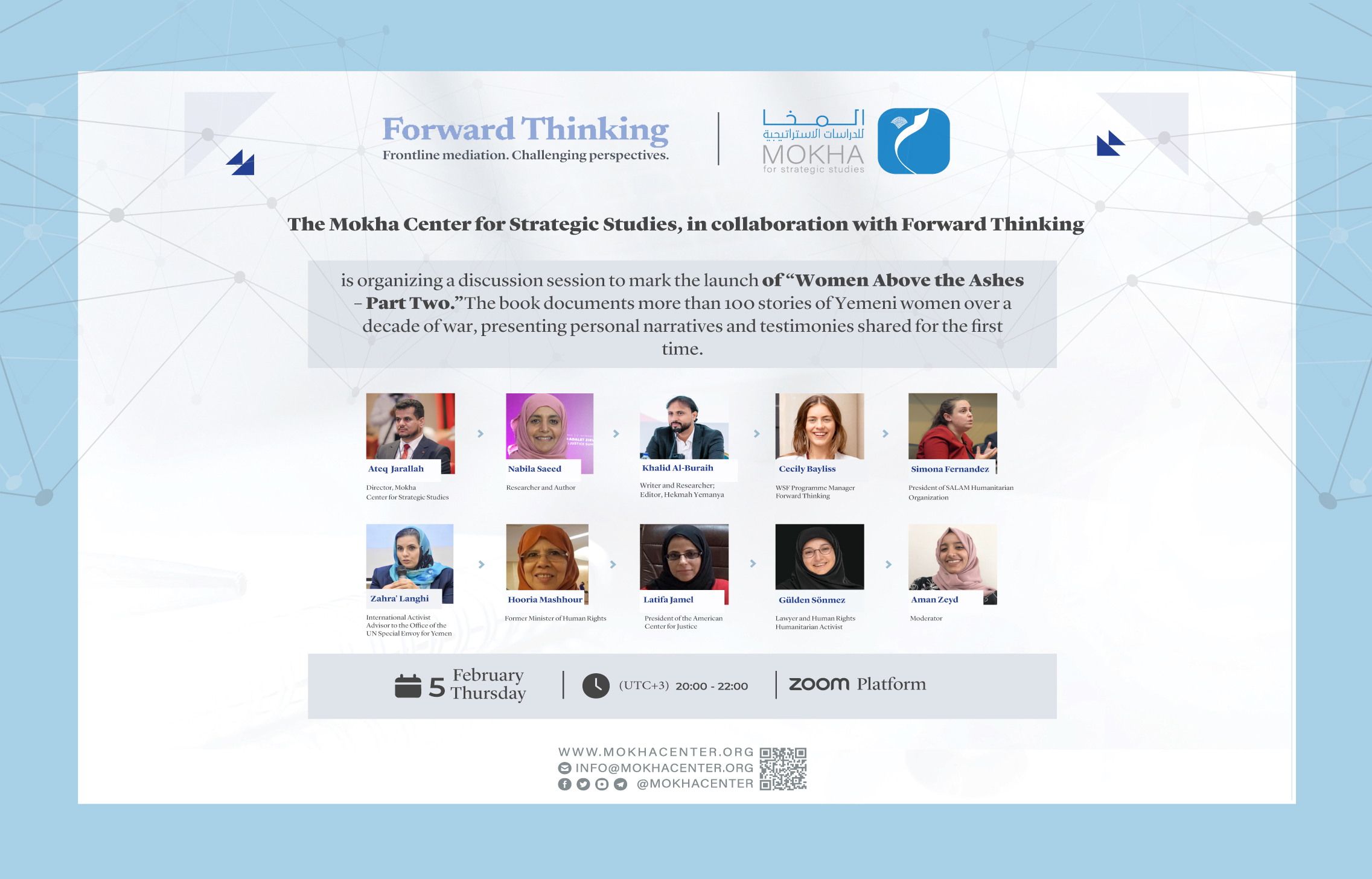
Al Jazeera Mubasher covered the book launch live with the author, then followed by an online seminar in collaboration with Forward thinking organization, that brought together academics, researchers, and international activists. The discussions addressed the impact of war on women amid rising global conflicts and declining international media attention to Yemen’s humanitarian crisis.
In his remarks, Ateq Jarallah, Director of the Mokha Center for Studies, described the book as the outcome of an intensive research and humanitarian effort that took nearly a year to complete. He emphasized its significance in capturing the depth and complexity of Yemeni society, noting that the narratives extend beyond women’s individual experiences to reflect the realities faced by entire families, including children, people with disabilities, the injured, migrants, and detainees. Jarallah described the work as “a collection of narratives that are both deeply painful and profoundly illuminating,” adding that the publication deliberately avoids political and military rhetoric in favor of highlighting stories of resilience and achievement, guided by the belief that “lighting a candle is more meaningful than cursing the darkness.”
Author Nabila Saeed explained that Women Above the Ashes is the result of years of demanding fieldwork, including access to besieged areas and active conflict zones. The project involved interviews with approximately 120 women, from which 100 stories were selected. These accounts document experiences of sniper fire, landmines, persecution, displacement, and extreme poverty. Despite severe trauma and loss, Saeed noted that many of the women were able to continue their education and enter the workforce, often becoming the primary breadwinners for their families, particularly in displacement settings characterized by a near-total absence of basic services.
The author stressed that war and displacement undermine not only women’s physical safety but also their economic and social stability, significantly limiting their ability to shape their own life trajectories. She added that refugee women face compounded challenges, including caregiving responsibilities, language barriers, and the lack of recognition of professional qualifications.
The online seminar also featured contributions from international researchers, who emphasized that gender-based violence frequently intensifies during armed conflict, especially in contexts marked by institutional collapse and weak protection mechanisms. They noted that women often become central actors in sustaining their communities, assuming informal leadership roles in response to the absence of the state and essential services.
In her intervention,Simona Fernandez, Head of the Italian organization Salam argued that the book offers a critical re-examination of the concept of resilience, suggesting that women’s endurance often reflects a forced substitution for missing institutions rather than resilience by choice. She highlighted the book’s focus on the largely invisible labor women perform to maintain social cohesion during times of crisis, stressing that women’s rights should not be understood solely through laws and policies, but through an analysis of how the burdens of war are distributed within societies. While Yemen provides a stark illustration of these dynamics, she noted that similar patterns can be observed in conflict zones worldwide, giving the book broader humanitarian relevance beyond its local context.
Khaled Al-Buraih described the second volume of Women Above the Ashes as an exceptional humanitarian record that presents Yemeni women not merely as victims of war, but as active agents of survival and change. He emphasized that the book’s central message lies in women’s ability to rise from the ashes, transforming suffering into a source of strength for themselves, their families, and their communities.
Women Above the Ashes stands as a historical and social record of Yemeni women’s experiences during years of conflict. More than a work of documentation, it serves as a call for moral responsibility and sustained support for Yemeni women as a cornerstone of social resilience and future recovery.
