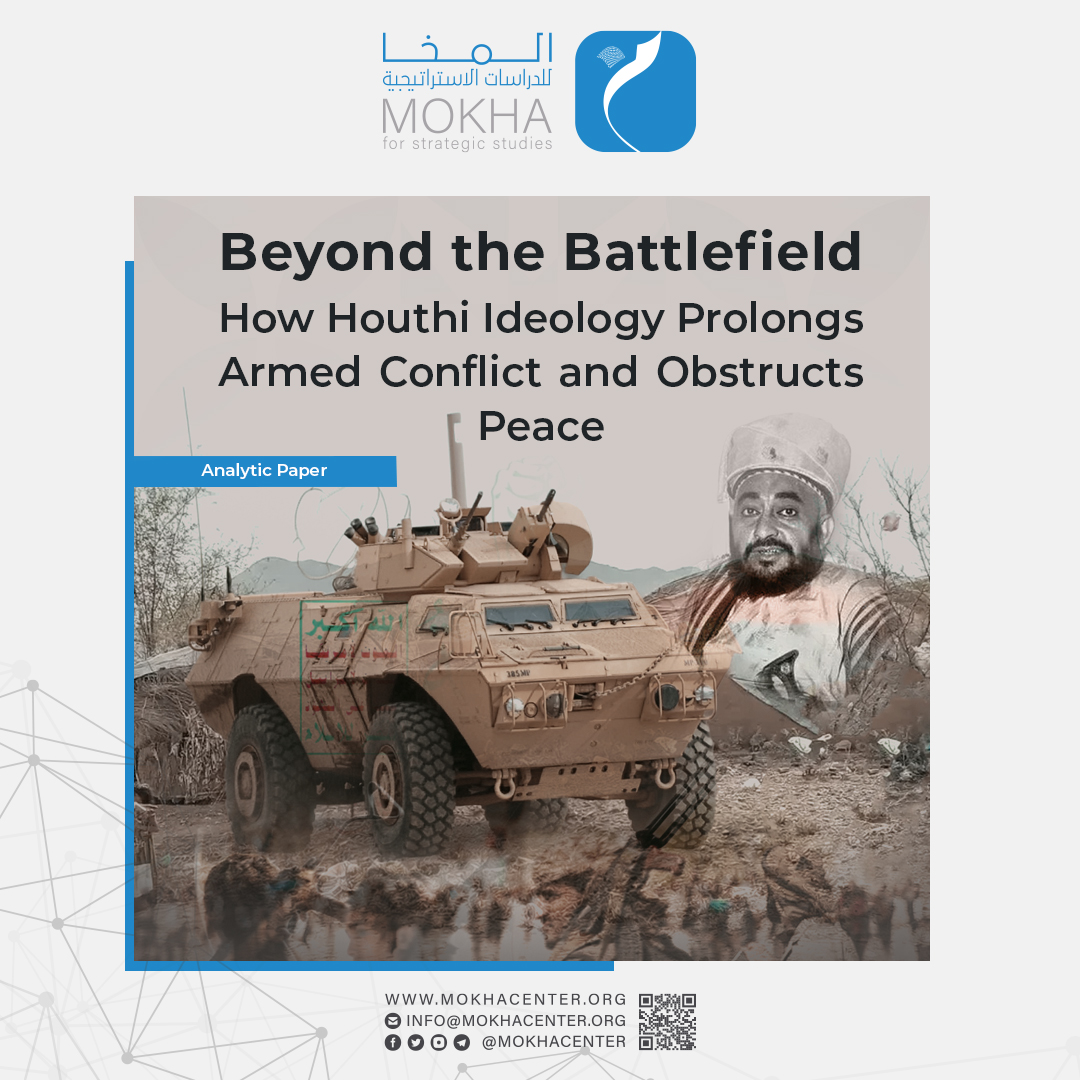
Beyond the Battlefield: How Houthi Ideology Prolongs Armed Conflict and Obstructs Peace
Introduction
The Houthi movement has adopted a comprehensive ideological framework that not only shapes its internal identity and reinforces loyalty among its followers but also directly contributes to prolonging the ongoing armed conflict in Yemen. At the core of this ideology lies several key concepts:
- the doctrine of wilayah (divinely sanctioned leadership),
- the construction of a perpetual sense of victimhood,
- claims of divine right to rule,
- notions of ethnic superiority,
- the indoctrination of education and culture,
- the mobilization of nationalist sentiment, and
- an ideology of taxation and war-economy practices.
This paper employs both the case-study approach and ideological-political analysis to examine how Houthi ideology contributes to extending the duration of the armed conflict and obstructing the prospects of achieving sustainable peace and state-building in Yemen.
A Never-Ending Wilayah
Nothing explains the role of Houthi ideology in prolonging the armed conflict as accurately as examining the doctrine of wilayah, which functions as a form of leadership with no end. This concept is deeply rooted in Yemen’s political and religious history. When Yahya ibn al-Husayn al-Rassi — known as al-Hadi — arrived in Yemen in 284 A.H., he waged long wars against Yemeni tribes to establish an entity separate from the Abbasid state. Wilayah served as the ideological cornerstone of his mission and his wars against Yemenis.
Al-Hadi built his political theory on the claim that most of the Prophet’s Companions after his death — foremost among them Abu Bakr and Umar — had manipulated religion and the concept of bay‘ah (allegiance), usurping the caliphate without right. According to this narrative, they deprived Ali ibn Abi Talib of his legitimate leadership, which, in Houthi ideology, is considered a divine selection exclusive to the Prophet’s household, a hereditary right granted by God to the Prophet’s descendants alone, to the exclusion of all others.
The Houthi movement today represents a contemporary embodiment of an ideology of perpetual wilayah (divinely ordained leadership). In its “Cultural and Intellectual Document,” issued on 13 February 2012, the group adopted the theory of the two descendants (nadhariyat al-batnayn), which restricts governance to the lineage of Hasan and Husayn, the sons of Ali ibn Abi Talib (may Allah be pleased with him). This is presented as a perpetual divine privilege that remains valid until the end of time.
Based on this doctrine, the Houthis believe they possess a special and exclusive entitlement to monopolize political authority in Yemen. They view themselves as holders of a divine right that was “usurped,” beginning with the selection of Abu Bakr (may Allah be pleased with him) at the Saqifah of Banu Sa‘idah and ending with the 26 September 1962 Revolution. In line with this ideological perspective, the group adopted — after the 21 September 2014 coup — policies that undermine the foundations of the modern state, equal citizenship, the principle of power transfer through elections and free democratic competition. They have instead positioned their leader, Abdul-Malik al-Houthi, as a figure “chosen by God.”
The movement’s discourse during the annual “Day of Wilayah” events demonstrates that, in their ideological framework, governance and political legitimacy rest upon the doctrine of wilayah as an extension of a theocratic chain that begins with God’s authority, followed by the alleged will of the Prophet, proceeds through the will of Ali, and culminates with what they call “the symbols of guidance,” “the infallible imams,” and “the divinely selected leaders.” From this ideological lens, the group presents its current leader as the natural contemporary extension of this divine hierarchy and the rightful holder of authority (wilayat al-amr) in Yemen. Obedience to him is portrayed as a religious duty, while rejecting his authority is framed as deviation from the path of faith, opposition to divine will and a violation of prophetic guidance.
On another front, the group has worked to institutionalize its monopoly over power and influence by seizing leadership positions within the state’s civil, military and security institutions, as well as key posts across the administrative apparatus and local authorities. This has been carried out through a genealogical network of individuals who are loyal to the movement, ensuring that political and administrative decision-making in Yemen remains concentrated in their hands, while the rest of Yemenis become ruled subjects rather than genuine partners in governance.
Manufacturing Victimhood
The Houthi movement relies on a historical narrative that is continuously reproduced as an ideological legacy adaptable for political use across different eras. This narrative claims that the Prophet’s family (peace be upon him) suffered injustice and persecution after his death at the hands of the Companions, who — according to the Shi’a narrative — allegedly revealed long-hidden resentment toward Ahl al-Bayt, usurped Ali’s divinely ordained right to lead the Muslim community, and replaced divine selection with mechanisms of bay‘ah (pledge of allegiance) and shura (consultation), thereby distorting religion itself.
In the present context, the Houthis have employed this fabricated victimhood narrative extensively. The group’s founder, Hussein Badr al-Din al-Houthi, crafted a provocative ideological discourse portraying the Zaidi community as living in a state of “humiliation and submission,” claiming that their condition is worse than the humiliation that befell the Children of Israel.
Within this charged atmosphere, the movement adopted an ideology of “historical victimhood,” portraying the Zaidis as a marginalized minority since the fall of the Imamate in 1962. This served to convince their local supporters that they are engaged in a sacred struggle to reclaim their stolen historical rights, rather than pursuing a mere political contest for power. The group also developed an external narrative framing the six wars it fought against the Yemeni army (2004–2010) as a confrontation between the oppressed and oppressors — an approach that helped them gain sympathy from certain international actors that champion minority rights. More significantly, it won the support of major powers promoting policies of empowering minorities in Muslim-majority countries to advance their own strategic agendas. These factors collectively strengthened the Houthi movement’s position, facilitated its takeover of the Yemeni state, and contributed to prolonging the armed conflict and complicating prospects for peace.
Despite the shift in the balance of power in favor of the Houthis following their coup on 21 September 2014 — transforming them from a hunted rebel group into an authority controlling the capital, the state, and its sovereign, economic and social institutions — the movement continues to employ the narrative of victimhood. It persists in reinforcing a sense of collective grievance to sustain mobilization and recruitment, embedding victimhood, oppression, and the duty of vengeance at the core of its political ideology. This, in turn, contributes to the prolongation of the armed conflict and the rejection of any political settlement that does not grant them exclusive rule as a divine right and the highest privileges of power, wealth and status in society.
In final analysis, invoking claims of victimhood produces a sharp conflictual worldview that fuels and sustains armed confrontation. It spreads a culture of hatred within society, grounded in resentment and revenge, transforming the conflict into a zero-sum struggle against the national state project based on peaceful power transfer, equal citizenship and the people’s right to choose their leaders and elected institutions. Ultimately, this turns armed conflict into a tool for monopolizing governance and safeguarding the exclusive privileges of power and wealth, undermining the possibility of reaching a comprehensive political settlement that could lead to establishing a just and lasting peace in Yemen.
Ideologizing Education and Public Culture
The Houthi movement employs a systematic strategy of mobilization and propaganda aimed at reshaping public discourse, controlling it, and creating a societal mindset that is heavily infused with the group’s ideology.
In the school sector, the movement has introduced profound changes to government curricula in areas under its control. These changes carry a sectarian dimension intended to reinforce claims of divine selection and hereditary racial superiority of the Houthi lineage over the rest of the Yemenis — ultimately undermining human rights, destroying the principle of equal citizenship and marginalizing justice.
Alarmingly, the group has instituted curriculum revisions that provide sectarian ideological justifications for war. These revisions legitimize violence against opponents through racially charged sectarian labels, such as “hypocrites” and “traitors,” encourage students to join the battlefield and create an entire generation of schoolchildren indoctrinated with a combat-oriented worldview. Houthi wars are portrayed as sacred jihad and sacrifices made for the sake of God.
The movement has also removed content on political participation, democracy, civil society and women’s rights from school textbooks. Furthermore, the group has added new subjects to core curricula in primary schools that include lessons featuring images of weapons and combat scenarios. High school students undergo weapons training and more-intensive ideological indoctrination in preparation for their involvement in the movement’s activities.
Students are also required to listen to lectures by the group’s founder, Hussein Badr al-Din al-Houthi, while Houthi officials regularly deliver mobilization sessions promoting the fight against their opponents under the banner of “jihad in the path of God.”
On another front, the movement places significant emphasis on political and cultural indoctrination saturated with its ideology. The Houthis use what they call “cultural courses” as a strategic mobilization tool to prolong the armed conflict by instilling absolute loyalty to the group’s leader and its sectarian values. These courses focus on dismantling the inclusive Yemeni national identity and replacing it with a sectarian identity referred to as the “faith identity,” inspired by the Malazim (pamphlets) of Hussein al-Houthi. These texts, written in colloquial dialect and later compiled into doctrinal booklets treated as sacred, serve as the primary material through which recruitment and mobilization are presented as religious obligations. This process deepens social divisions, legitimizes the group’s militarized roles and extends the duration of the armed conflict. In this way, indoctrination becomes a mechanism that perpetuates continuous military mobilization and reinforces political and social domination.
The ideologization of education and public culture does not merely function to recruit a new generation of fighters by framing combat as jihad in the path of God and portraying opponents as hypocrites and traitors. Rather, it seeks to ensure ongoing recruitment for protracted wars that intensify internal divisions within Yemeni society, obstruct pathways to ending the armed conflict, and further delay the prospects of establishing genuine and sustainable peace.
Stirring Nationalist Sentiment
One of the striking paradoxes of the Houthi movement is that, while it has undermined the republican system through an armed coup and torn apart the social fabric by promoting doctrines of divine selection and hereditary supremacy, it simultaneously employs this very ideology to provoke nationalist sentiment among Yemenis. The group frames itself as a defender of national sovereignty and dignity against foreign aggression.
The movement previously achieved some success in using this narrative to counter the support provided by the Arab Coalition to the legitimate government. It later gained broader and more influential traction by capitalizing on its own aerial attacks on targets in Israel, on commercial and military vessels in the Red Sea, and on the subsequent Israeli, American and British airstrikes on Yemen — strikes that resulted in civilian casualties and the destruction of key infrastructure, such as the ports of Hodeidah and Salif, as well as the electricity and energy stations in Sana’a.
These events enabled the Houthis to renew their ideological mobilization discourse, blending themes of nationalism with religious sanctities — such as sovereignty, dignity, Yemeni bravery, resistance to aggression, jihad, sacred duty and support for the oppressed.
This fusion allowed the movement to sustain fighter recruitment and attract large segments of citizens who do not traditionally belong to its ideological base. All of this was directed toward reinforcing internal dominance and prolonging the armed conflict under the pretext of resisting foreign aggression.
The final report of the UN Security Council’s Panel of Experts, issued in October 2024, revealed evidence that the Houthi movement exploits such events to deepen internal divisions and extend the duration of the armed conflict. Each new wave of recruitment is followed by an expansion in the scope of fighting — especially since the group uses these mobilization waves to create a significant shift in the balance of power between itself and the legitimate Yemeni government. Under the banner of “Al-Aqsa Flood,” the Houthis were able to increase their number of fighters from 220,000 in 2022 (before the events) to approximately 350,000 fighters at the time this report was prepared.
The Ideology of Taxation and War Financing
The Houthi movement has significantly expanded the use of its ideology to build a war economy, initiating major structural and legislative changes — such as legalizing, what they call, the “khums” (the one-fifth levy), establishing a Zakat Authority, and inventing new religious rituals as channels for further revenue extraction. Among these tools, khums stands out as one of the most dangerous strategic instruments in the group’s taxation ideology.
In 2020, the movement introduced serious amendments to Yemen’s Zakat Law No. 2 of 1999 through, what they labeled, the “Executive Regulation of the Zakat Law.” These amendments allocated exclusive privileges to those they described as “Bani Hashim” in state revenues, distinguishing them from the rest of Yemenis. Under this amendment, the group granted itself the authority to seize 20% of Yemen’s wealth, stipulating the extraction of khums from oil, minerals, gold, fish resources, livestock and animal products, honey, agricultural crops, commercial profits, companies and various other citizen-owned revenues — allocating these proceeds to members of that lineage.
Through these measures, the movement sought to grant religious and legal legitimacy to the growing system of “taxation,” which has become one of the most crucial tools of the war economy, providing sustainable financial resources that prolong the armed conflict and enable the group to mobilize fighters based on genealogical privilege.
On another front, the Houthis established a fully-fledged taxation structure under the name of the “Zakat Authority,” aimed at redirecting zakat collected from citizens, traders and business owners toward financing the war effort. This was justified through their ideological interpretation of the Qur’anic verse on the distribution of zakat “in the path of God” — interpreted by the group to mean warfare, even when that warfare is, in fact, directed against Muslims (the Yemeni army and the legitimate government).
The group imposed strict regulations on collection, created a unified accounting system, and compelled traders and business owners to pay zakat for previous years retroactively. Zakat was collected from every economic activity, no matter how small — from livestock herding to real estate. The revenues of the Zakat Authority exceeded 150 billion Yemeni riyals, equivalent to more than $630 million US, with annual increases of no less than 30% over the past four years.
While less than 30% of zakat funds go to support the poor, the group’s war effort consumes 60% of zakat revenues. Funds are transferred directly into the “fi sabilillah” (in the cause of Allah or for the sake of God) account and are used to finance the movement of the group’s leaders, stipends for their fighters and families, and medical treatment for war casualties.
Through this ideological manipulation of the religious practice of zakat, the Houthi movement has constructed a logistical financing tool that enables it to control local resources, create an extensive network of beneficiaries and channel these resources toward prolonging the armed conflict.
In the same context, the Houthi movement has developed what can be described as “ritualized taxation practices” by transforming its religious symbols and commemorations into tools of mobilization and financial extraction that contribute to prolonging the armed conflict. The group has introduced numerous ideological occasions celebrated throughout the year, such as Wilayah Day (Ghadir Day), the anniversary of the martyrdom of Imam Ali, the anniversary of the martyrdom of Imam Husayn (Ashura), the anniversary of Imam Zayd’s martyrdom, the anniversary of Saleh al-Sammad’s assassination, the anniversary of Hussein Badr al-Din al-Houthi’s death, the Prophet’s Birthday, Fatima’s Birthday, Martyr’s Week, “The Cry” Week, the 21 September anniversary, “Day of Steadfastness,” Rajab Friday, International Quds Day, the anniversary of the Battle of Badr, the Hijri New Year, and the anniversary of Imam al-Hadi’s arrival in Yemen.
These occasions are not merely religious rituals; they are political and economic mobilization seasons designed to create a continuous flow of human and financial resources. During these events, the movement imposes levies on traders, business owners and ordinary citizens under various labels, such as “the war effort” and “support for the front-line fighters,” thereby increasing their financial burdens. This is accompanied by social and religious pressure, as well as direct threats — including confiscation of goods, closure of shops and the imposition of fines and legal bonds — to coerce compliance. In addition, these occasions have negative repercussions for Yemen’s cultural identity and social cohesion.
Thus, the Houthi movement transforms ideological rituals and commemorations into financial extraction seasons that enable it to fund mass recruitment, war logistics and the continuation of the armed conflict.
In final analysis, this triad — khums, zakat and ritualized taxation practices — has created a war economy that prolongs the armed conflict and obstructs peace. The war economy, which has been established and relied upon by the group to generate resources, stands in stark contradiction to calls for lasting peace and stability. It undermines the very possibility of a just state — one that alone possesses the constitutional authority to collect and distribute revenues — and it poses a sectarian threat with serious implications for social coexistence and communal integration in Yemen.
Is There a Way Out?
It has become clear how Houthi ideology — rooted in the doctrines of wilayah, divine selection and hereditary superiority — contributes to prolonging the armed conflict. The experiences of many countries that have undergone similar wars and internal strife offer an invaluable lesson that must not be ignored: Any national project seeking to end the war, rebuild the state and establish sustainable peace must be founded on equal citizenship and popular legitimacy — not on granting a single lineage of citizens the exclusive privilege of ruling while subjecting the rest of the population to subordinate status.
In the current armed conflict, which has persisted in Yemen for more than 11 years and devastated both society and economy, one of the most essential requirements for escaping this national tragedy is the pursuit of two parallel paths:
First Path:
Any future political settlement must adopt constitutional and legal measures that abolish the doctrine of wilayah, divine selection and hereditary superiority, as well as must criminalize claims or practices that discriminate among Yemenis on genealogical, sectarian or regional grounds. It should also prohibit the establishment of political parties or groups on sectarian, ethnic or regional bases. Complementary to this, school curricula must be reviewed, religious and cultural discourse moderated, and religious and educational institutions rebuilt on inclusive national foundations.
Second Path:
Moderate Zaidi scholars and religious leaders must undertake a courageous historical reassessment of the doctrine of wilayah, the claims of divine selection and the illusion of hereditary superiority. They must affirm that governance is a right belonging to the Yemeni people — with all their diverse orientations and affiliations — and that political authority should be transferred through free and democratic choice, which forms the basis of legitimacy. Yemenis of all families, sects and regions must be recognized as equal, with no preference for one over another.
In our assessment, if such measures and reforms were to take place, they would open the door widely to ending the war, restoring the cohesion of Yemeni society, achieving economic, political and social development, attracting regional and international support and investment, and rebuilding the institutions and structures of a modern, lawful Yemeni state capable of ensuring lasting peace and stability for Yemen, the region and the world.