Taiz and the Cost of the Siege The Economic Impact of Houthi-Imposed Road Closures
Executive Summary
The Houthi militia’s military escalation in September 2026 led to the closure of the last remaining alternative routes into Taiz city, intensifying a siege that has been in place since 2015. The resulting economic burden falls directly on civilians, who bear the cost of every additional litre of fuel consumed, every extra hour spent on the road, and every levy imposed at checkpoints.
This report draws on documents from the governorate’s Transport Office and Office of Industry and Trade, field interviews, and direct monitoring of market prices. Its key findings include:
- Transport: The number of trucks arriving from Aden and Al-Hawban fell by approximately 80%. The cost of transporting one tonne of goods from Aden rose from YER 40,000 to YER 100,000, while a journey that previously took three hours now takes an entire day. Meanwhile, 83.5% of local public transport buses have ceased operations.
- Prices and Energy: Cooking gas prices rose by approximately 173%, petrol by 79%, and flour by 47%, while petroleum products are being sold on the black market.
- Trade: Many traders have been unable to bring goods into the city, while financial transfers to Aden, where goods are imported, have been disrupted.
- Households: Low-income households have resorted to firewood as an alternative to cooking gas, amid stagnant incomes and rising prices.
- Public Revenue: The governorate is losing approximately YER 8 million per month in transport-related fees.
The report concludes that the siege is being used as a tool of collective punishment and that measures taken by local authorities can mitigate the crisis but cannot resolve it as long as the roads remain closed.
The report recommends the immediate and unconditional reopening of roads, ensuring the delivery of fuel, cooking gas, and essential supplies, providing urgent assistance to affected households, drivers, and traders, and documenting violations and holding those responsible accountable.
Introduction
Since 2015, Taiz city, home to more than 2.5 million people, has been under a siege imposed by the Houthi militia on its main access routes. Direct roads linking the city to Aden, Lahj, Hodeidah, and the western coast have been closed, forcing residents to rely on alternative mountainous and rural routes that were never designed to accommodate heavy freight traffic. Over the years, however, these routes became the city’s only lifeline for the movement of goods, fuel, and passengers.
In September 2026, the siege entered a more severe phase as the closures extended to these alternative routes. The Mocha–Al-Kadha–Al-Birein road was closed at the outset of the offensive, while the Houthis’ destruction of a drainage culvert (bridge) in Hayjat Al-Abd severed the Aden–Al-Turbah–Taiz road. In early October, the Al-Hawban–Al-Aqrud–Al-Misrakh road, which had served as the main corridor for transporting goods into the city, was also closed. Travellers and transport operators were left with only one route, where Houthi checkpoints determine when passage is permitted. Those using it cannot predict when they will arrive, or whether they will reach their destination that same day.
The cost of these conditions extends well beyond the difficulty of travelling. Every additional hour a driver spends on the road, every extra litre of fuel consumed by a truck, and every levy paid at a checkpoint ultimately feeds into the price of goods purchased by households, the bus fares paid by employees, students, and workers, and the cost of the cooking gas used to prepare daily meals.
Against this backdrop, the report examines the economic and household costs of the siege following its latest escalation, tracing how disruptions to road access affect markets and, ultimately, household livelihoods. It addresses several key questions: What has changed in road access and transport operations? How have these changes affected transport costs and trade? What has been the impact on the prices of essential goods and fuel, and on household living conditions? To what extent can measures taken by local authorities mitigate these effects?
The report draws on official documents issued by the Taiz Governorate Transport Office, the General Authority for the Regulation of Land Transport Affairs, and the Office of Industry and Trade. It also incorporates supplementary field interviews with a driver, a trader, and a head of household; direct monitoring of essential commodity and petroleum product prices in the city’s markets during the siege; and data from the Taiz Human Rights Center on property damage in rural areas.
The report is organised into several sections. It begins by examining road access, entry points, and checkpoints, before assessing the impact of the siege on heavy freight and local transport, trade and financial transfers, commodity and fuel prices, and household livelihoods. It then presents a preliminary summary of economic losses, evaluates the measures taken by local authorities, and concludes with findings and recommendations.
Road Closures and the Use of Access Routes as Instruments of Siege
Before the war, roads leading to Taiz were relatively short and direct. The Karsh–Al-Hawban road connected the city to Aden and Lahj, while the Hayjat Al-Abd–Al-Turbah road linked it to the south. Routes through Hodeidah, the airport area, and Bir Basha provided access to the west and the coast. As the siege began, the Houthi militia progressively closed these roads, forcing transport operators and travellers to seek alternative routes through mountainous and rural areas.
Alternative routes subsequently emerged, including the Sami’ road, the Al-Aqrud road connecting Al-Hawban to Al-Hujariyah and Taiz city, the Najd Qusaim road, the Tur Al-Bahah–Al-Turbah road, and the Al-Kadha road linking the western coast to the city via Mocha and Al-Birein. Although these routes were never designed to accommodate heavy freight vehicles, they gradually became essential lifelines for the city.
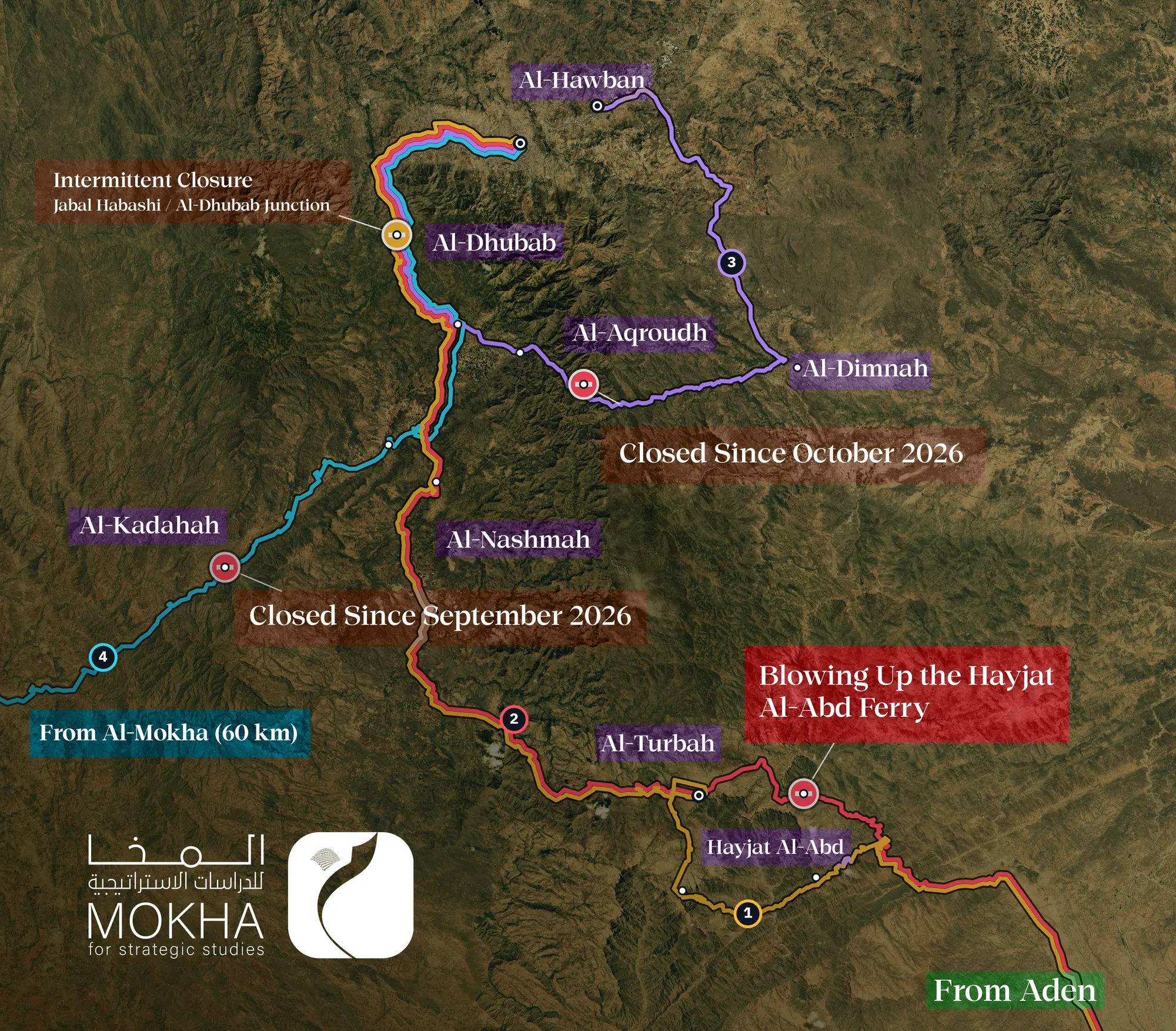
The latest escalation has extended the closures to these alternative routes. A comprehensive report prepared by the Taiz Governorate Transport Office and submitted to the Deputy Governor for Services, a copy of which was obtained by the research team, documents the status of the main access roads as follows:
Table 1. Status of Main Access Roads to Taiz City
| Road | Current Status | Details |
| Aden–Karbat Al-Suhhi–Al-Turbah–Al-Nashmah–Taiz city | Closed, with intermittent openings | Closed at the Jabal Habashi or Al-Dhabab junctions at various times, with occasional openings in the morning or afternoon. |
| Aden–Hayjat Al-Abd–Al-Turbah–Al-Nashmah–Taiz city | Closed | It remained open until the militia destroyed the drainage culvert at Hayjat Al-Abd. |
| Al-Hawban–Al-Aqrud–Al-Misrakh–Taiz city | Closed | Closed in early October 2026; previously the main corridor for transporting goods from Al-Hawban. |
| Mocha–Al-Kadha–Al-Birein–Taiz city | Closed | Closed since the beginning of the militia’s offensive in September 2026. |
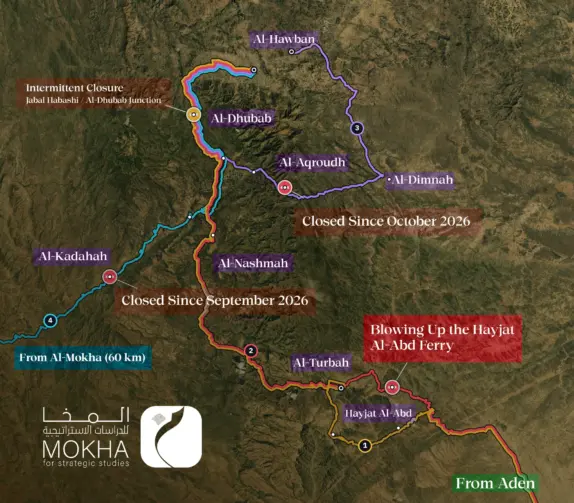
Map showing the closure of the main roads leading to Taiz city by the Houthi group.
The restrictions extend beyond the main roads. According to the Transport Office, the Houthi militia has also taken control of secondary roads in the districts it has reached, including Al-Shamaytayn, Al-Ma’afir, Al-Mawasit, Sami’, and Jabal Habashi.
The route currently used by travellers between Aden and Taiz city, via Al-Turbah, Al-Nashmah, and Al-Birein, is subject to closures at Al-Dhabab and the Jabal Habashi junction. It is sometimes opened early in the morning, sometimes in the afternoon, and on certain days remains closed entirely. As a result, travellers leaving their homes have no way of knowing when they will arrive at their destination, or whether they will arrive that same day.
Table 2. The Siege in Numbers: Key Indicators Before and After the September 2026 Escalation
| Indicator | Before | After | Change |
| Freight cost per tonne | YER 40,000 | YER 100,000 or more | 150% increase |
| Travel time from Aden to Taiz | Approximately 3 hours | 26 hours | Approximately 8.7 times as long |
| Trucks arriving from Aden and Al-Hawban | Normal traffic levels (exact figures unavailable) | Approximately 20% of normal traffic levels | 80% decline |
| Buses operating on 24 local routes | 2,216 | 365 | 83.5% decline |
| Cooking gas cylinder | YER 11,000 | YER 30,000 | 173% increase |
| Food basket for a family of five | YER 200,000 | YER 350,000 | 75% increase |
| Transport fee revenue lost by local authorities in the districts | Regularly collected | Approximately YER 8 million per month in lost revenue | Monthly loss of public revenue |
Checkpoints Control Residents’ Daily Lives
Anyone entering or leaving Taiz city must pass through a series of checkpoints established by the Houthi militia along the remaining roads. According to the governorate’s Transport Office, the main checkpoints include Al-Dhabab, the Jabal Habashi junction, Al-Birein, Ras Najd Qusaim, Al-Nashmah, Al-Safiyah, and Al-Turbah, in addition to others along secondary roads connecting the districts.
At these checkpoints, travellers leaving the city, as well as those arriving from the Al-Hujariyah districts, are subjected to intrusive and extensive vehicle searches, forced to disembark, detained for hours, and sometimes denied passage altogether. The official report states that passenger vehicles travelling in both directions are held for several hours each day, while freight trucks arriving from the Port of Aden are also detained.
The Transport Office acknowledges that it has been unable to document these violations comprehensively because it lacks trained representatives stationed at the checkpoints. The incidents recorded here therefore represent only a minimum account of what travellers experience on these roads, rather than a complete picture.
The Cost of the Siege: Trucks Consume 700 Litres Instead of 300
Truck drivers are among the first to bear the cost of longer routes. In an interview conducted by the report’s field research team, a truck driver described the difference between transport conditions before and after the siege of Taiz, beginning with fuel consumption:
“Before the current war, a truck consumed around 300 litres of fuel per trip. Today, it consumes 700 litres or more because of the longer distances and difficult road conditions.”
The driver then explained how journey times have changed. Before the war, travelling from Aden to Taiz took approximately three hours; today, the same journey takes around 26 hours. As a result, a truck now completes only one journey in the time it previously took to make several, leaving its owner to cover all operating expenses from that single trip.
The driver added that these costs include increased vehicle maintenance expenses caused by travelling on rough roads, the need for regular repairs, and the cost of spare parts. Freight charges have also risen sharply:
“The cost of transporting one tonne of goods used to be no more than YER 40,000. By the time this report was prepared, it had reached around YER 100,000 or more.”
The driver attributed these increases to longer journeys, repeated checkpoints, and the continued imposition of levies by the Houthis. These costs are ultimately passed on through higher prices for goods and essential commodities entering Taiz, placing an additional financial burden on residents.
Table 3. Heavy Freight Transport Costs Before the Siege and at Present
| Indicator | Before the Siege | Currently | Change |
| Fuel consumption per trip | 300 litres | 700 litres or more | 133% increase |
| Travel time from Aden to Taiz | Approximately 3 hours | One full day | Approximately eight times as long |
| Freight cost per tonne | YER 40,000 | YER 100,000 or more | 150% increase |
Source: Field interview with a truck driver.
The Siege Erodes What Remains of Household Incomes
The field research team monitored the prices of several essential commodities in the city’s markets before and after the latest escalation. Price increases varied across products, with substantial rises recorded for several staples, particularly sugar, infant milk powder, and flour.
Table 4. Prices of Essential Food Commodities (YER)
| Commodity | Before the Siege | After the Siege | Price Increase |
| Al-Sanabel flour, 50 kg bag | 36,000 | 53,000 | 47.2% |
| Sugar, 50 kg bag | 49,000 | 62,000 | 26.5% |
| Cooking oil, 8 litres | 22,000 | 25,500 | 15.9% |
| Nido powdered milk for children, 200 g | 5,000 | 6,000 | 20.0% |
| Al-Fakhama rice, 10 kg | 21,000 | 24,000 | 14.3% |
| Rice, 50 kg bag | 82,000 | 85,000 | 3.7% |
The increases in fuel and cooking gas prices were considerably sharper. The price of a cooking gas cylinder rose from YER 11,000 to YER 30,000, an increase of approximately 173%. Petrol prices climbed from YER 28,000 to YER 50,000, a rise of nearly 79%, while diesel prices increased from YER 44,000 to YER 50,000, or approximately 14%.
These are the prices residents face when the products are available at all. According to the Transport Office, petroleum products are unavailable at the city’s official fuel stations, and the limited supplies that remain are sold on the black market.
Table 5. Petroleum Product and Cooking Gas Prices
| Product | Before the Siege (YER thousands) | After the Siege (YER thousands) | Price Increase |
| Cooking gas | 11 | 30 | 172.7% |
| Petrol | 28 | 50 | 78.6% |
| Diesel | 44 | 50 | 13.6% |
Source: Field monitoring, October 2026.
The significance of these figures extends well beyond fuel stations. Petrol and diesel costs are reflected in the fares charged by every bus and the freight rates of every truck, while cooking gas is essential to preparing daily meals. Any increase in these costs therefore feeds directly into other prices, placing further pressure on low-income households.
To understand what these figures mean at the household level, the research team interviewed a low-income father supporting a family of five, as an illustrative case. Asked about the cost of the basic food basket his family purchases, including wheat, sugar, oil, rice, and milk, he explained that it previously cost around YER 200,000, equivalent to approximately SAR 500. Today, the same basket costs around YER 350,000, or approximately SAR 875, representing an increase of nearly 75%.
Describing how rising fuel and cooking gas prices have affected his family’s daily life, he said:
“As for cooking gas, we have had to use alternatives such as a wood-burning stove. But finding firewood has also been difficult, so we have had to buy it from a bakery that uses firewood.”
This account illustrates the conditions facing many low-income households in the city, which now confront a difficult combination of limited incomes, rising prices, scarce transport services, and an acute shortage of cooking gas.
Traders Face a Double Burden
In an illustrative interview conducted by the field research team, a food trader who sources goods from Al-Hawban and Aden began by describing the rise in transport costs:
“Before the siege, transporting a 50-kilogram bag of goods from Al-Hawban to Taiz city cost no more than YER 1,000. Today, the cost has increased fivefold to YER 5,000 via the alternative route through Al-Barh and Mocha.”
For goods arriving from Aden, the trader explained that freight charges have risen from YER 40,000 per tonne before the siege to YER 100,000 today, increasing the financial burden on traders and driving up commodity prices in local markets.
The trader also noted that the consequences of road closures extend beyond transport costs to financial transfers between Taiz and Aden:
“We traders face difficulties transferring money from Taiz to Aden, as some exchange companies refuse to process these transactions. Some traders are forced to carry the money themselves to Aden to complete the transfers, exposing them to additional risks and financial costs.”
Traders thus face a double burden: higher freight charges and the risks of personally transporting cash through the same checkpoints where trucks are routinely detained.
The trader added that the price of a 50-kilogram bag of goods has increased by approximately YER 5,000 compared with the period before the siege, illustrating the extent to which rising transport costs and road closures have affected commodity prices and commercial activity in the city.
Table 6. Impact of the Siege on Trade Costs
| Indicator | Before the Siege | Currently | Change |
| Transporting a 50 kg bag of goods from Al-Hawban to Taiz city | YER 1,000 | YER 5,000 | Fivefold increase |
| Freight cost per tonne from Aden | YER 40,000 | YER 100,000 | 150% increase |
These findings are consistent with the Transport Office’s report that most traders have been unable to transport their goods into the city, resulting in shortages of food and essential commodities and depriving traders of previously earned revenue. The official report describes the resulting losses as incalculable.
Preliminary Estimates of Losses
Based on field testimonies and official documents, the economic and social damage resulting from the siege and its latest escalation can be summarised as follows:
Table 7. Summary of Economic and Household Impacts
| Sector | Impact |
| Local transport | Approximately 83.5% of passenger transport vehicles have ceased operations. The number of buses operating on 24 local routes has fallen from 2,216 to 365, resulting in daily losses of millions of Yemeni rials for drivers and vehicle owners. |
| Heavy freight transport | Freight costs have risen from YER 40,000 to YER 100,000 per tonne, fuel consumption has increased by 133%, and journeys that previously took three hours now take 26 hours. |
| Trade | An 80% decline in trucks arriving from Aden and Al-Hawban, disruptions to financial transfers to Aden, and substantial losses for traders. |
| Public revenue | Monthly losses of approximately YER 8 million in transport fees collected across the districts, including YER 1.43 million in Sabr Al-Mawadim alone. |
| Infrastructure | The destruction of the drainage culvert at Hayjat Al-Abd, severing the Aden–Hayjat Al-Abd–Al-Turbah road. |
| Household livelihoods | A 75% increase in the cost of the basic food basket, a 173% rise in cooking gas prices, and households resorting to firewood and reducing food consumption. |
| Energy | Petroleum products are unavailable through official channels and are sold on the black market, while petrol prices have risen by approximately 79%. |
| Property in rural areas | Raids and looting affecting 374 homes, the complete or partial destruction of 264 homes, and the seizure of 120 healthcare facilities. |
Limited Response Measures Amid a Deepening Crisis
In response to the crisis, the Taiz Governorate Office of Industry and Trade says it took early action to secure the city’s food supplies. Its director, Abdulrahman Al-Qulay’ah, explained that the office adapts its policies to the circumstances facing the governorate and had taken precautionary measures during the war and siege to establish food reserves in anticipation of emergencies.
Al-Qulay’ah added that the office worked to ensure the equitable distribution of essential food supplies, particularly amid panic buying that prompted some residents to purchase large quantities and stockpile them at home. He explained:
“Our primary objective was to secure large quantities of food to replenish reserves and increase market supply, helping to balance supply and demand. We achieved this, then moved to regulate prices, taking into account the relative increase in transport costs and levies resulting from fuel shortages and the risks associated with supply routes.”
Al-Qulay’ah maintained that essential food commodities are currently being sold at officially approved prices. Addressing price differences between retailers, he explained that the domestic trade law allows businesses to compete in the sale and pricing of goods within legal regulations. These include setting maximum price limits to prevent excessive pricing and requiring traders to display price lists. Market inspections, he added, are continuing to ensure compliance.
He also noted that the office operates a 24-hour operations room, with contact numbers published on its official page, alongside the Rasd (Monitoring) platform, which receives public complaints and initiates the necessary legal measures against violations.
However, compliance with official prices does not mean that prices have remained unchanged. Official prices are set with consideration for rising transport costs and levies, and have therefore increased accordingly, as reflected in the price changes documented in this report.
Moreover, Al-Qulay’ah’s remarks concern essential food commodities, not petroleum products, which the Transport Office confirms are unavailable in the city’s official fuel stations. The limited supplies that remain are sold on the black market, outside any official pricing mechanism.
Nevertheless, the effectiveness of local authorities’ efforts, regardless of their scale, remains constrained by the volume of goods that can enter the city. Food reserves cannot be replenished without open supply routes, and price controls alone cannot offset the cost of a journey that consumes 700 litres of fuel and passes through multiple checkpoints.
Conclusion
The findings of this report indicate that the Houthi militia is deliberately imposing a punitive siege on the residents of Taiz city. By closing roads, destroying drainage culverts, detaining travellers and freight trucks at military checkpoints, and imposing levies, the Houthis have steadily increased the cost of daily life for the city’s population.
Freight costs per tonne have more than doubled, while the journey from Aden, which previously took three hours, now takes approximately 26 hours. Of the 2,216 buses that once operated on local routes, only 365 remain in service. The price of a cooking gas cylinder has risen from YER 11,000 to YER 30,000, while the cost of a basic food basket for a family of five has increased from YER 200,000 to YER 350,000. Together, these increases place a growing financial burden on residents whose opportunities to earn a stable income are diminishing as the siege intensifies.
International humanitarian law prohibits the use of starvation of civilians as a method of warfare. Restrictions on access to food, fuel, and other essential supplies may, under certain circumstances, constitute war crimes. In Taiz, such restrictions have persisted for more than a decade, yet no one has been held accountable.
Measures taken by local authorities, including maintaining food reserves and monitoring prices, may alleviate the crisis but cannot resolve it. Food stocks will eventually be depleted as long as roads remain closed. Meanwhile, an international response limited to monitoring effectively allows the siege to continue and encourages those imposing it to tighten restrictions further.
The report therefore recommends the immediate and unconditional reopening of roads, ensuring access to essential supplies, providing urgent assistance to affected households, drivers, and traders, and documenting Houthi violations and holding those responsible accountable. Every additional day of road closures imposes further costs on the livelihoods and health of Taiz residents.