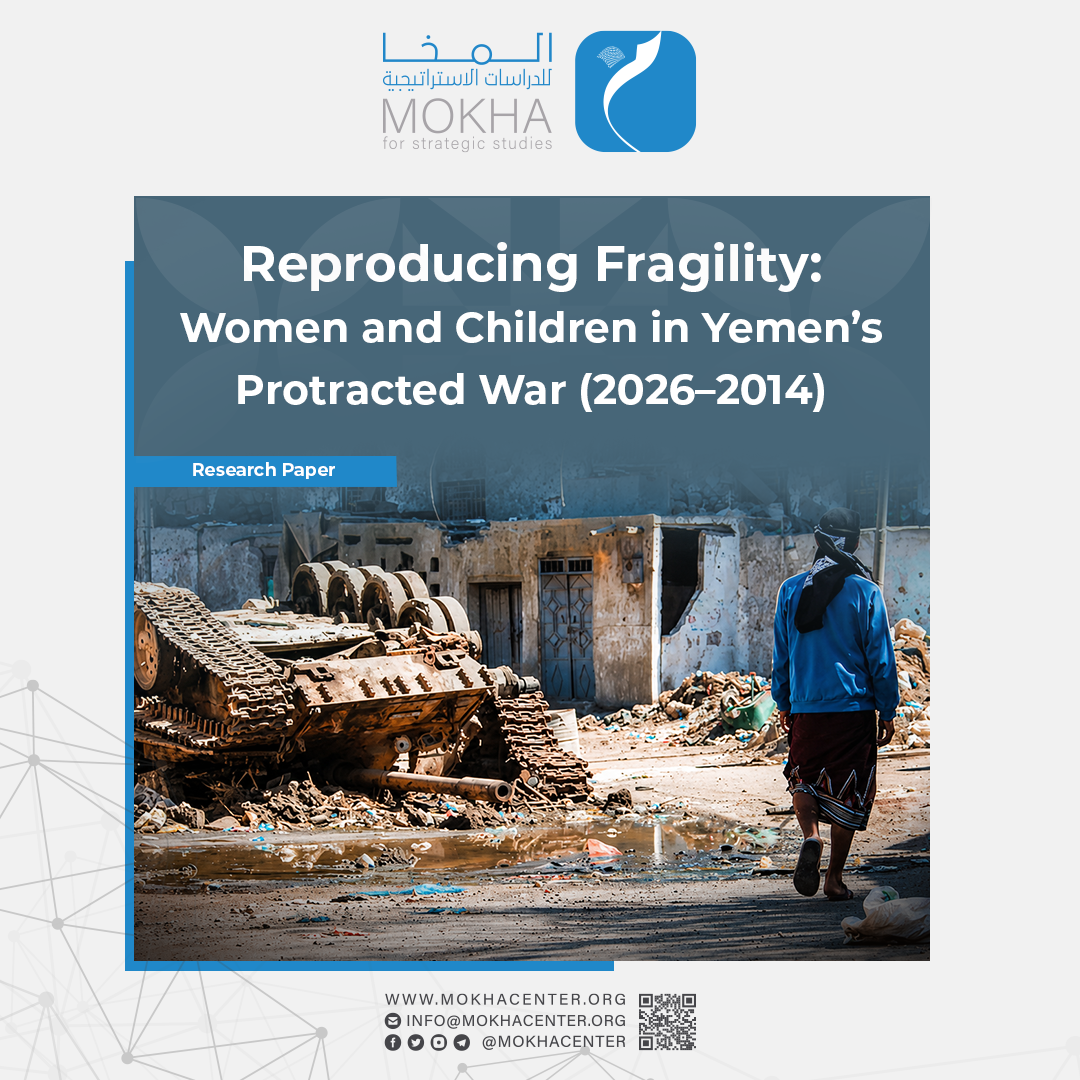
Reproducing Fragility: Women and Children in Yemen’s Protracted War (2014–2026)
Dr. Ismail Al-Suhaili
Nearly twelve years after the Houthi coup of September 2014, Yemen remains trapped in a protracted war that has generated one of the world’s most severe humanitarian crises. Its impact has extended far beyond deteriorating living conditions, inflicting widespread damage on critical infrastructure, including roads, bridges, power stations, hospitals, schools, universities, and factories. The United Nations Development Programme (UNDP) estimates that the conflict has set Yemen’s human development trajectory back by approximately 21 years, with recovery to pre-war levels likely to require many more years.
This sustained deterioration across key sectors has entrenched Yemen’s position among the world’s most fragile environments. According to the 2025 Global Peace Index, the Institute for Economics and Peace ranks Yemen as the least peaceful and most dangerous country in Asia, with a score of 3.397, the highest in the region.
Taken together, these indicators point to the cumulative impact of a protracted conflict that has steadily eroded the resilience of Yemeni society and weakened its capacity to absorb mounting economic, social, and security pressures. Within this broader landscape of fragility, women and children remain among the most exposed groups, bearing a disproportionate share of the human costs of armed conflict.
Against this backdrop, the study addresses a central question: How has Yemen’s protracted war (2014–2026) contributed to deepening the vulnerability of women and children, and what are the principal dynamics through which this vulnerability is produced and manifested?
To examine this question, the study adopts a descriptive-analytical approach to assess the dimensions of vulnerability intensified by the conflict. Its analytical framework draws on the concepts of vulnerability and human security as complementary lenses for understanding the mechanisms through which fragility is reproduced among women and children in Yemen, as well as its main manifestations and consequences. The study further relies on data and statistics drawn from credible local and international reports and studies to support the analysis and trace the evolution of these dynamics over the period 2014–2026.
Dynamics of Reproducing Fragility: An Analytical Framework
Drawing on contemporary literature on fragility, as well as the World Bank Group’s Strategy for Fragility, Conflict, and Violence, which links exposure to risk with limited capacity to manage and withstand it, this study understands fragility as a multidimensional condition in which heightened exposure to risks intersects with limited capacity to confront and manage them. It reflects weaknesses in individual and institutional capacities and a declining ability to respond effectively to shocks.
In the context of protracted wars, fragility is understood not as a static condition but as a dynamic process that develops and deepens over time through the interaction between shocks and existing social, economic, and institutional structures. Declining levels of human development, the erosion of capacities, and the weakening of protection systems can entrench cycles of deprivation and reproduce them over time. From this perspective, fragility provides an analytical lens for examining how war leaves women and children more exposed to its burdens and consequences while simultaneously reducing their capacity to cope with and recover from them.
This approach is complemented by the concept of human security, which shifts the analytical focus toward the security, lives, dignity, and basic needs of individuals. The 1994 Human Development Report issued by the United Nations Development Programme (UNDP) advanced a conception of human security centred on people rather than territory and on development rather than an exclusive focus on instruments of power. It broadened the understanding of security to encompass threats affecting individuals’ lives and well-being, while emphasizing access to essential resources and services and the strengthening of resilience.
Accordingly, the study adopts an integrated analytical framework combining the concepts of fragility and human security, with each serving a distinct analytical function. Fragility helps explain how vulnerability emerges and accumulates by focusing on exposure to risk, limited capacities and resources, and constrained coping mechanisms. Human security, in turn, helps identify the domains in which this fragility becomes visible and the threats it poses to people’s lives, rights, dignity, and access to food, healthcare, education, income, protection, and personal safety. Combining the two therefore enables a dual analysis: first, of the pathways through which fragility is produced and reproduced; and second, of the areas in which it manifests and its consequences for human security.
In the Yemeni context, the Houthi coup of 21 September 2014 and the protracted war that followed have deepened economic, social, security, and psychological fragility and transformed these vulnerabilities into more persistent patterns. This process has been driven by the destruction of resources and infrastructure, the weakening of institutions and public services, restrictions on livelihoods, expanding displacement and food insecurity, heightened risks of violence and exploitation, and the erosion of both formal and community-based protection mechanisms.
The reproduction of fragility in Yemen is also highly uneven. Women and children face overlapping risks shaped by their economic and social position, weakened protection systems, and unequal access to resources and services. Women often shoulder additional burdens following the loss of household income or a primary breadwinner, while simultaneously facing heightened risks of violence, displacement, exploitation, and extortion. Children, meanwhile, face disrupted education, malnutrition, recruitment, exploitation, and begging, with long-term consequences for human capital formation and their future opportunities.
The significance of examining the vulnerability of women and children therefore extends beyond the fact that they are among the groups most severely affected by the conflict. Some of the harms they experience can themselves become mechanisms through which future fragility is produced, allowing the consequences of the war to persist across generations in Yemen.
Food Insecurity: Poverty, Hunger, and the Deepening of Fragility
Nearly twelve years of war have severely weakened household incomes and livelihoods across Yemen, making food insecurity both one of the clearest manifestations of fragility and a major driver of its reproduction. The erosion—and, in many cases, complete loss—of regular income has undermined households’ ability to secure food consistently, forcing many families to adopt increasingly severe coping strategies, including reducing the quality and quantity of food and cutting daily consumption to two meals or, in some cases, a single meal. World Bank estimates indicate that more than 60% of households experience inadequate food consumption.
As livelihoods have deteriorated, a growing share of households has become dependent on humanitarian assistance. The United Nations projected that more than 22 million Yemenis would require assistance during 2026. In his briefing to the UN Security Council on Yemen on 16 June 2026, the UN Under-Secretary-General for Humanitarian Affairs and Emergency Relief Coordinator warned that the humanitarian crisis was accelerating and hunger levels were rising. More than 18 million Yemenis were already experiencing acute hunger, while the proportion of people unable to secure sufficient food had risen from 50% to nearly 60% in the space of a single month. He described the deterioration as unfolding faster than the humanitarian response could contain it. Around five million people were facing severe hunger, with roughly a quarter of them living under critical emergency conditions, while more than 2.2 million children under the age of five were suffering from acute malnutrition amid broader economic deterioration and the collapse of health services.
The same pattern is reflected in the findings of the Multidimensional Poverty Measurement in Yemen conducted by the United Nations Development Programme. The study found that 82.7% of the population was living in multidimensional poverty, while the intensity of poverty stood at 46.7%, highlighting the accumulation of multiple and overlapping forms of deprivation, including food insecurity.
Taken together, these indicators illustrate the scale of the war’s impact on Yemenis generally, and on women and children in particular. For these groups, the reproduction of fragility is more acute. Declining household food and economic resources reshape the distribution of responsibilities within families: women assume greater economic and caregiving burdens, while children become increasingly vulnerable to school dropout and to income-generating activities such as early labour, recruitment, and begging.
At the same time, inadequate food consumption and declining dietary diversity and quality increase the risk of malnutrition, particularly among young children and pregnant and breastfeeding women. The consequences extend well beyond immediate deprivation. Childhood malnutrition can impair physical and cognitive development, educational attainment, and future opportunities. Malnutrition among women, particularly during pregnancy and breastfeeding, can also heighten health risks within the household.
In this way, the effects of poverty and hunger extend from present deprivation into future vulnerability. By weakening human capital and constraining long-term capabilities, food insecurity becomes not only an outcome of Yemen’s conflict, but also a mechanism through which fragility is reproduced across generations.
Declining Humanitarian Response and Dignity-Eroding Coping Strategies
After nearly twelve years of war, international humanitarian assistance has become one of the main mechanisms cushioning Yemen’s most vulnerable households from mounting economic and social pressures. In recent years, however, international reporting has pointed to a sharp decline in funding for humanitarian response programmes. By September 2025, only 19% of the $2.5 billion response plan had been funded—the lowest level in more than a decade.
By 2026, fragility had increasingly shifted from a temporary condition into a chronic feature of daily life. In his briefing to the UN Security Council on Yemen on 16 June 2026, the UN Under-Secretary-General for Humanitarian Affairs and Emergency Relief Coordinator warned that the 2026 Humanitarian Response Plan was facing an unprecedented funding shortfall, with less than 15% of the required financing secured.The scale of the deficit forced international agencies to reduce or suspend critical life-saving programmes, including direct food assistance and emergency healthcare. He further warned that, if this trajectory continued, millions of Yemenis could be pushed closer to famine.
The contraction in international humanitarian funding has also pushed large numbers of Yemeni households toward coercive coping strategies that undermine human dignity, including resorting to begging after losing the ability to meet basic needs and absorb repeated shocks. The loss of breadwinners, shrinking employment opportunities, displacement, rising living costs, and the erosion of formal and community-based protection and solidarity mechanisms have made women and children particularly vulnerable to this form of coping.
Under such conditions, begging can shift from a temporary survival strategy into a recurring source of household income, particularly where families lack access to more sustainable alternatives. Its risks are especially acute for women and children who increasingly spend time on streets, outside mosques, and near commercial premises, where prolonged exposure can heighten their vulnerability to exploitation, violence, and violations of human dignity.
Ultimately, this form of forced adaptation is a structural indicator of both the limitations of the humanitarian response and the failure of protection systems to contain the cumulative effects of more than a decade of war. At the same time, it has become an important mechanism through which the vulnerability of women and children is reproduced. While begging may provide households with an immediate means of survival, it can also undermine their longer-term capabilities when it contributes to loss of education, exposure to violence and exploitation, and the erosion of human dignity.
Erosion of Protection Systems and the Expansion of Violence and Exploitation
Women and children are among the groups most exposed to social vulnerability in countries affected by armed conflict, particularly where households and communities have limited capacity to absorb or adapt to economic and social shocks or to maintain adequate living standards. Under such conditions, they become more vulnerable to violence, exploitation, marginalization, and exclusion. Fragility therefore becomes a continuing process, reproduced through the interaction of economic, social, security, and psychological pressures, particularly as formal and community-based protection networks erode.
In Yemen, the weakening of formal and community protection systems has increased women’s and children’s exposure to the consequences of war and widened the range of risks they face. These have included killing and injury, recruitment, sexual violence, and arbitrary detention. Impunity, weak legal frameworks, and the limited capacity of law-enforcement institutions have further created an environment in which such violations can persist. Women have been particularly exposed to violence as protection mechanisms have deteriorated, raising the risk that fragility will be reproduced across generations. United Nations estimates indicate that around 6.2 million women and girls across Yemen face heightened risks of violence, while one in three women experiences some form of gender-based violence, underscoring both the scale and increasingly widespread nature of the phenomenon.
Alongside these established forms of violence and exploitation, electronic blackmail has emerged as another serious threat to women, with potentially severe consequences for their vulnerability. According to the October 2025 report Between Oppression and Abandonment, issued by the Yemeni Women Empowerment Foundation, suicides among women and girls increased during the war, with at least 22% of recorded cases linked to electronic and emotional blackmail. Such abuse has included hacking social media accounts, obtaining personal photographs or private data from online profiles, and accessing material during the repair of mobile phones or laptops, followed by threats to publish or circulate it.
The danger of this form of violence is particularly acute in a conservative and socially sensitive environment, where breaches of privacy, reputational harm, and the circulation of personal images or videos can place women and girls at serious risk. Around 5,000 cases of blackmail were recorded during 2020–2021, while approximately 25 women and girls were reportedly subjected to such violations each day, with cases concentrated among those aged 21–24. The risks extend beyond violations of privacy. In the absence of effective official and social protection, and amid widespread impunity, the psychological and social pressures associated with stigma can contribute to suicide and, in some cases, expose victims to violence or killing by relatives seeking to avoid perceived social shame.
From a human security perspective, these indicators reflect the failure of formal, family, and community protection systems to safeguard the personal and psychological security of women and girls. In this context, suicide cannot be understood solely as an isolated individual act, detached from a harsh environment in which the accumulated consequences of war have generated new forms of violence directed at an already vulnerable segment of Yemeni society. Without stronger protection mechanisms and greater accountability, the risks associated with these patterns are likely to persist and potentially intensify.
For children, the erosion of formal and community-based protection systems has likewise created greater space for exploitation and violence, most visibly through child recruitment. Poverty, displacement, and, in some cases, the loss of a family breadwinner can push children toward recruitment, turning vulnerability itself into a resource that is exploited within the conflict. Child recruitment therefore represents a compounded form of fragility in which the economic, social, and security consequences of war intersect, leaving children simultaneously affected by vulnerability and targeted for exploitation.
The United Nations’ 2023 report on Children and Armed Conflict documented 1,056 verified cases of child recruitment during 2022, involving 933 boys and 123 girls. Children were used in direct combat roles as well as for guarding, transporting ammunition, and staffing checkpoints, with some of those recruited under the age of 15. These figures reflect the extent to which the conflict has penetrated an already fragile social environment. Child recruitment is closely linked to the erosion of formal and community-based protection systems, deepening poverty, and disruption to education. The United Nations also verified 544 cases of children killed and 158 cases of maiming, in addition to incidents of sexual violence, underscoring the multiple forms of abuse to which children are exposed.
UNICEF data indicate that 80% of recruitment by the Houthi group takes place through summer centres established for school students in areas under its control, with reports that recruitment is facilitated through financial incentives of up to YER 20,000 per month.[18] The UN Security Council Panel of Experts on Yemen also documented eight recruitment cohorts involving an estimated 56,000 children across several governorates, alongside the recruitment of girls for logistical and intelligence-related roles. It further recorded 21,342 violations between 2015 and 2025, as well as the use of 852 schools for sectarian mobilization.[19] Taken together, these findings illustrate how children’s vulnerability can be transformed into a resource for exploitation within the conflict, contributing to the reproduction of violence and the deepening of fragility.
Ultimately, the erosion of formal and social protection systems emerges as one of the key mechanisms through which the vulnerability of women and children is reproduced in Yemen. As protection systems weaken, exposure to violence and exploitation increases. Reducing this vulnerability therefore requires rebuilding legal and institutional protection frameworks, accelerating the recovery of social protection systems, strengthening accountability and redress mechanisms, and addressing the persistence of impunity. It also requires ensuring that victims can access essential services as well as psychological and social support.
Displacement as a Driver of Reproduced Fragility
Internal displacement is one of the most significant mechanisms through which fragility has been reproduced during Yemen’s protracted war, particularly among women and children. Displacement from one’s home is itself a profound shock, often resulting in the loss of shelter, sources of income, assets, and social support networks. According to the 2023 Global Report on Internal Displacement, Yemen had approximately 4.5 million internally displaced persons, with women and children accounting for nearly 75% of the total. The United Nations Office for the Coordination of Humanitarian Affairs (OCHA) in Yemen later reported that the number of internally displaced people had risen to approximately 5.2 million by March 2026. These figures highlight the protracted nature of displacement and its transformation from a temporary emergency into a long-term living condition.
Displacement-related fragility is reflected in the loss of resources, assets, and livelihoods, as well as in reduced access to essential services, particularly education, healthcare, water, and protection. These pressures become more severe when displaced households have lost their sources of income or become disconnected from their social networks, including family members, relatives, friends, and neighbours. Forced relocation into unfamiliar environments, where households often lack the resources needed to rebuild their livelihoods, increases dependence on humanitarian assistance and can push families toward negative coping strategies.
Women and children frequently bear a disproportionate share of these consequences. Displacement increases the economic and social burdens placed on women, particularly in households that have lost a breadwinner, while also heightening their exposure to violence, exploitation, and weakened protection. Children face increased risks of interrupted education, child labour, exploitation, and recruitment, alongside reduced access to healthcare and adequate nutrition. In this way, displacement-related fragility intersects with economic and social vulnerability and child protection risks, extending the effects of displacement beyond immediate living conditions to individuals’ longer-term opportunities.
The risks associated with displacement become even more pronounced when protection systems are weak. The loss of family, community, and formal institutional ties increases displaced households’ exposure to risk and leaves them more dependent on limited and unstable resources. Displacement therefore does not reproduce fragility in isolation. Rather, its effects are compounded by poverty, food insecurity, declining public services, and weakened formal and social protection systems, transforming the initial shock of displacement into a chain of cumulative pressures that deepen and reproduce fragility.
Fragility of Human Capital
The erosion of human capital is one of the most significant manifestations of the vulnerability facing women and children as a result of Yemen’s protracted war. This fragility has been reinforced through the deterioration of three closely interconnected dimensions: education, health, and nutrition. The Yemen 2025 Annual Strategic Report, published by Mokha Center for Strategic Studies, highlights a series of alarming indicators that illustrate the scale of this decline.
Education has been among the sectors most severely affected by the conflict. The destruction and closure of schools, displacement, worsening economic conditions, interruptions to teachers’ salaries, shortages of qualified staff, and insufficient educational resources have significantly widened barriers to access. Approximately 34.5% of school-age children are out of school, with even higher levels of exclusion among displaced children and children with disabilities. These figures point to a deepening vulnerability among Yemeni children. Educational disruption not only limits their ability to acquire the skills and qualifications needed for future economic and social participation, but also increases their exposure to harmful alternatives, including child labour, begging, and recruitment.
The deterioration of education has unfolded alongside a broader decline in healthcare and nutrition, further weakening the foundations of long-term human development. The degradation of Yemen’s health system has contributed to the resurgence of preventable diseases, including polio and diphtheria. At the same time, malnutrition indicators reveal severe levels of health and nutritional deprivation among women and children. According to data cited in Mokha Center’s annual strategic report, approximately 2.4 million children and 1.5 million pregnant and breastfeeding women suffer from acute malnutrition. The report also records high levels of wasting and underweight among children, alongside elevated maternal mortality.
The erosion of human capital, particularly among women and children, therefore represents a central mechanism through which fragility is reproduced over time. Deprivation in education, health, and nutrition weakens the individual and social capacities required for recovery and increases the risk that poverty and deprivation will be transmitted across generations. Rebuilding human capital is thus essential not only to addressing the immediate consequences of war, but also to breaking longer-term cycles of fragility and strengthening Yemen’s capacity for recovery and resilience.
Deepening Psychological Fragility
As Yemen’s war has become increasingly protracted, the cumulative effects of violence, displacement, loss, and deprivation have intensified the psychological pressures facing women and children. This has unfolded against a backdrop of extremely limited mental health and psychosocial support services. Available indicators portray a deeply strained mental health landscape. According to UN agencies, large numbers of Yemenis suffer from war-related trauma and psychological distress. In 2025, an estimated seven million people required specialized mental health support, yet only around 120,000 had sustained access to such services. The country reportedly had just 46 psychiatrists, equivalent to approximately one psychiatrist for every 700,000 people.
A more recent study published in February 2026, titled The Silent Battle: After 11 Years, What War Has Done to Yemenis’ Mental Health, documented a broad spectrum of psychological disorders and trauma affecting Yemeni women and children. The study presents these conditions as a direct consequence of prolonged conflict and warns that, without adequate intervention, their effects are likely to persist over the long term, undermining coping capacity and potentially contributing to the reproduction of violence within Yemeni society.
The psychological impact on children is particularly severe. A 2019 field survey by Save the Children, based on a randomly selected sample of 1,250 Yemeni children aged 13–17, found that more than 50% experienced sadness and depression, 20% suffered persistent fear, 52% reported feeling unsafe, and 56% were afraid to walk alone. Thirty-eight percent experienced nightmares, while other symptoms included bedwetting (8%) and difficulty relaxing (16%). Children also displayed physical signs associated with anxiety, including heart palpitations, stomach pain, sweating, and trembling when frightened.
A further field study conducted in October 2025, covering 600 children across eight governorates—Taiz, Aden, Lahj, Abyan, Hajjah, Al-Dhalea, Al-Hudaydah, and Sana’a—showed even higher levels of psychological distress. It found that 73% suffered from post-traumatic stress disorder, 64% from anxiety, and 58% from depression. The effects extended into children’s social and educational lives, with 67% experiencing social isolation and 78% showing a decline in academic performance. Psychological vulnerability was particularly acute among children affected by enforced disappearance, who displayed symptoms including anxiety, depression, loss of emotional security, low self-esteem, aggression, and irritability.
Women have faced a parallel deterioration in psychological well-being, driven by the economic and social burdens associated with the loss of a breadwinner, increased responsibility for household provision, exposure to violence, the enforced disappearance of husbands, and the isolation associated with displacement. A field study of 600 women across the same eight governorates found that 67% experienced high levels of anxiety, 62% suffered from depression, and 59% from post-traumatic stress disorder. The study also reported that 38% had been exposed to physical violence, 72% to psychological violence, and 45% to economic violence, against a broader backdrop of weakened formal and community protection systems.
Another study published in October 2025 on the effects of enforced disappearance and arbitrary detention on women found that wives and female relatives of the forcibly disappeared experienced panic attacks during home raids, while some suffered miscarriages. It further reported that 70% of families included in the study experienced insomnia and daily episodes of crying, alongside related health problems such as hypertension, seizures, and depression.
Psychological fragility among Yemeni women and children therefore reflects a reinforcing cycle between exposure to trauma and limited capacity for response and recovery. War generates cumulative psychological distress, while weak mental health services and support networks allow its effects to persist. These effects can, in turn, deepen vulnerability and reduce the ability of women and children to cope with subsequent shocks. Addressing fragility therefore requires integrating mental health and psychosocial support into the broader conflict-response framework, not as a secondary intervention, but as a core component of strengthening resilience and breaking cycles of reproduced fragility.
Conclusion
The study concludes that the impact of Yemen’s war has extended far beyond immediate human and material losses. The conflict has contributed to the reproduction of social, economic, and psychological fragility, while widening exposure to risk and weakening the ability of women and children to access protection and essential services. Armed violence has intersected with economic deterioration, displacement, declining public services, weakened state institutions, and eroding protection systems, making fragility the cumulative outcome of multiple and overlapping risks.
The findings also show that the vulnerability of women and children is not a static condition, but a dynamic process that armed conflict reproduces over time. The longer the war continues, the more it weakens the capacity of households and communities to absorb shocks, erodes protection systems, and transforms what may initially be temporary consequences into chronic patterns of poverty, deprivation, displacement, violence, and exploitation. For women and girls, these risks intersect with gender-based violence, exploitation in both physical and digital spaces, and mounting psychological pressures. Children, meanwhile, face growing threats to their access to education, health, and safe development, potentially transforming the immediate effects of war into long-term losses in human and social capital.
From a human security perspective, these findings underscore that the protection of women and children cannot be addressed through emergency humanitarian programmes alone, particularly at a time when humanitarian funding is declining sharply. A more sustainable response requires rebuilding formal and community-based protection systems and public services, strengthening social safety nets, expanding access to education, healthcare, and mental health services, and addressing the security, political, economic, and institutional drivers that allow fragility to persist and reproduce itself.
Ultimately, ending the Houthi coup, restoring the state, and achieving sustainable peace in Yemen are presented as essential conditions for breaking the cycle of reproduced fragility. Doing so is critical to closing the protection and service gaps that have left women and children carrying a disproportionate share of the costs of war, and to restoring the conditions necessary for safe and dignified life while enabling Yemenis to move beyond fragility in all its forms.
