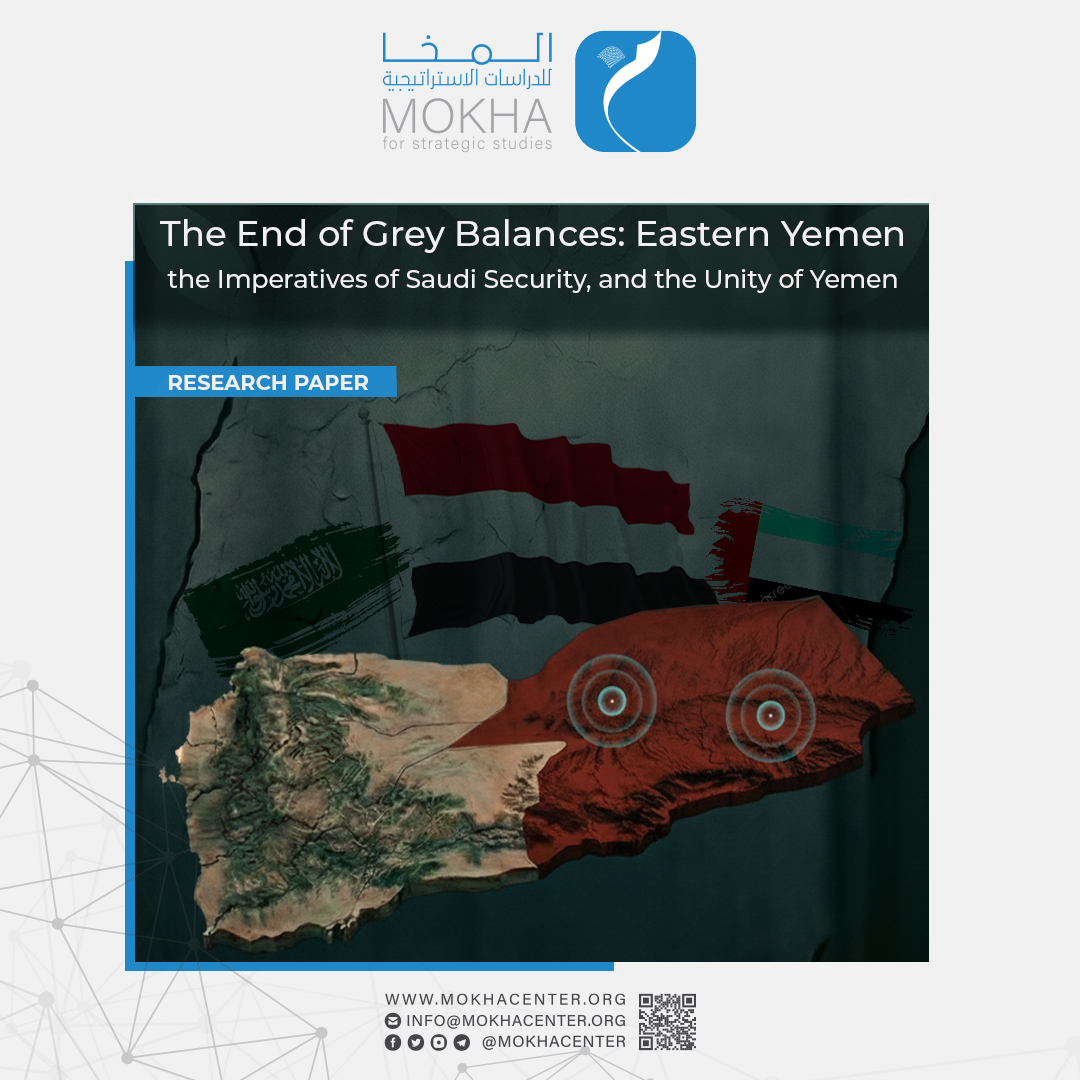
Eastern Yemen Current Development and Future Scenarios
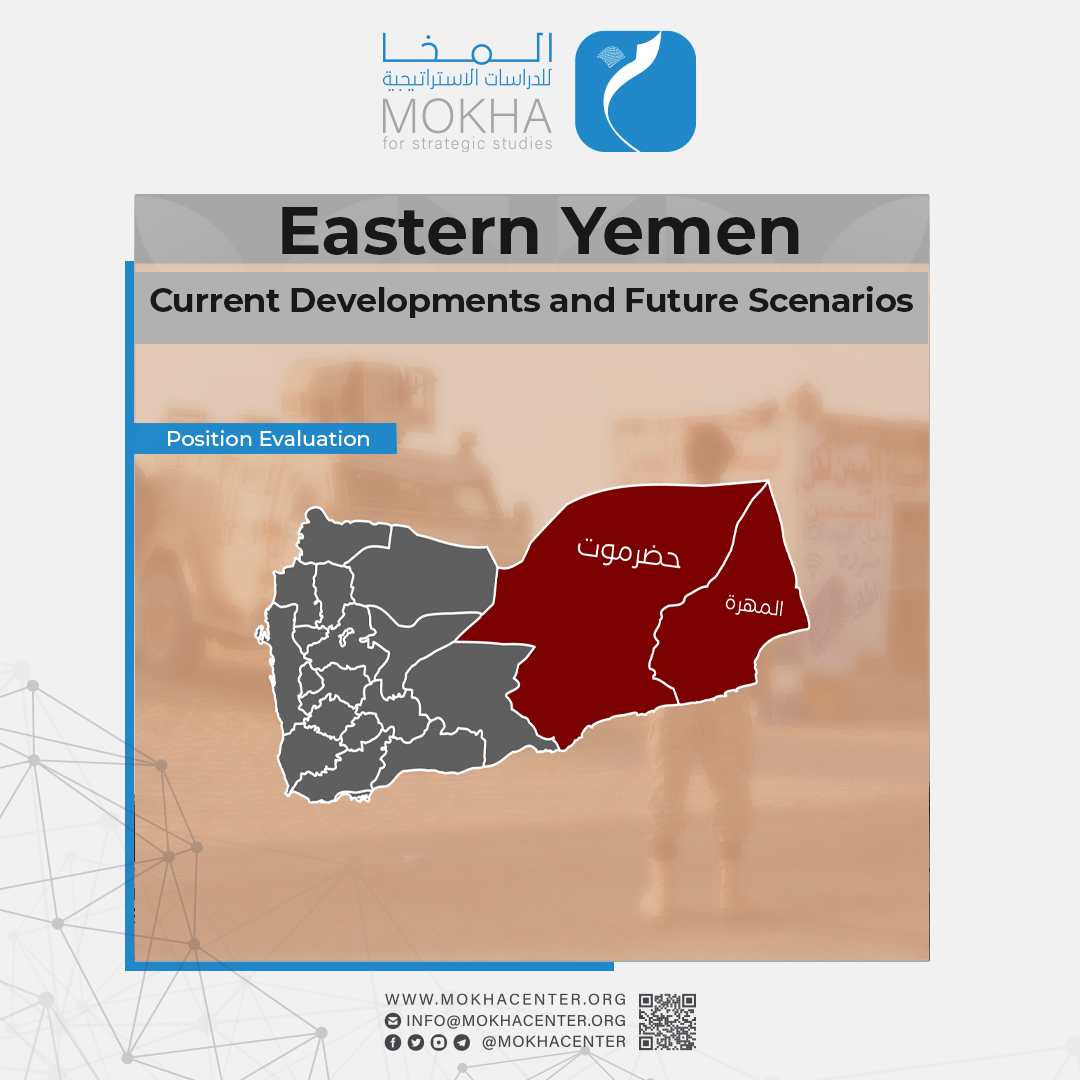
Sovereign Decisions
On December 30, 2025, President Rashad Al-Alimi, Chairman of the Presidential Leadership Council, decided to cancel the joint defense agreement with the United Arab Emirates and requested that all Emirati forces leave Yemeni territory within 24 hours. The decision marked a notable development following nearly a month of incursions by UAE-backed forces into the governorates of Hadhramaut and Al-Mahra.
Al-Alimi’s decision came as part of a broader set of measures that included declaring a 90-day state of emergency — extendable — as well as imposing an air, sea, and land blockade on all entry points for 72 hours, except for movements authorized by the Arab Coalition to Support Legitimacy.
The decisions followed an airstrike carried out by coalition fighter jets, led by Saudi Arabia, targeting weapons shipments transported by two Emirati vessels arriving from Fujairah Port, which had offloaded their cargo at the Port of Mukalla in Hadhramaut — part of the ongoing Emirati support to secessionist armed formations loyal to Abu Dhabi.
In the aftermath of the airstrike and the decisions issued by the Yemeni presidency, the Saudi Ministry of Foreign Affairs released a statement supporting the measures and describing the UAE’s actions in Yemen as “inconsistent with the foundations upon which the Coalition to Support Legitimacy was established.” The statement added: “We regret the pressure exerted by the UAE on the Southern Transitional Council to conduct operations in Hadhramaut and Al-Mahra, and we stress the importance of halting any military or financial support to any party inside Yemen.”
The UAE Ministry of Foreign Affairs responded to the Saudi statement, denying the accusations it contained and affirming that “its position since the beginning of the events in Hadhramaut and Al-Mahra has aimed at containing the situation and supporting de-escalation.” Abu Dhabi also denied “directing any Yemeni party to carry out military operations that would threaten Saudi security,” stressing its keenness on the security and stability of Riyadh and its full respect for Saudi sovereignty and national security.
Subsequently, the UAE Ministry of Defense announced that its forces in Yemen would begin to withdraw. Indeed, the forces quickly dismantled their camps and bases in Hadhramaut and Shabwa, and military personnel departed aboard several transport aircraft observed by eyewitnesses leaving Al-Rayyan Airport in Mukalla, only hours after President Al-Alimi’s decision and the Saudi Foreign Ministry’s statement.
In reaction to the presidential decisions, four members of the Presidential Leadership Council aligned with the UAE (Al-Zubaidi, Al-Bahsani, Al-Mahrami, and Tariq Saleh) issued a joint statement expressing their rejection of the measures and emphasizing that Abu Dhabi’s role had been positive and supportive in confrontations with the Houthis. While such a statement was expected, it simultaneously reinforced the narrative that the UAE supports certain actors and entities to establish parallel structures, alternative authorities, and armed formations outside the framework of the state’s official institutions — directing them toward its own objectives at the expense of the coalition’s declared goal of restoring legitimacy.
Toward Open Confrontation
Once it became clear that all domestic and external efforts had failed to calm the situation and restore conditions to what they were, the Yemeni presidency — with Saudi support — began taking practical measures aimed at asserting state authority and preserving sovereignty and territorial unity. Confrontation with the Southern Transitional Council (STC), politically and militarily if necessary, had become unavoidable — especially after all efforts at de-escalation and containment had been exhausted, and after the STC itself initiated escalation by ordering its forces to enter Hadhramaut and Al-Mahra.
According to the official Yemeni news agency, the National Defense Council, in an emergency meeting held late last month, approved a number of measures necessary to protect civilians, safeguard the state’s legal standing, and enforce its authority across political, security, economic, and administrative domains. These included a request to the Coalition to Support Legitimacy in Yemen to “take all necessary military measures to protect innocent civilians in Hadhramaut and support the armed forces in imposing calm.”
The coalition leadership responded to the Yemeni request by warning against any unilateral military action. Coalition spokesperson Brigadier General Turki Al-Maliki explained that the response came as a result of “grave and shocking humanitarian violations committed against civilians by armed elements affiliated with the Southern Transitional Council.”
The confrontation required advancing along several simultaneous tracks. The first was the political track, which provided cover for presidential actions and decisions. This included coordination with local authorities in Hadhramaut and Al-Mahra — both of which had from the outset declared support for presidential measures and Saudi efforts, and demanded the withdrawal of STC forces from the two governorates. Coordination also continued between the presidency and official institutions backing the presidential decision, including the Advisory Board, the National Defense Council, the leadership of the Ministry of Foreign Affairs and Yemeni diplomatic missions abroad, in addition to the country’s legislative institutions — the House of Representatives and the Shura Council — as well as political and social parties and groups.
This support was clearly reflected in the presence and endorsement of these bodies for the presidential measures, including the request submitted to the Arab Coalition leadership to move in defense of civilians in Hadhramaut and Al-Mahra — a step some observers saw as a prelude to direct confrontation with STC forces, whose incursions were increasingly viewed by the public and analysts as unilateral actions amounting to rebellion against state institutions and the national consensus process, including the Riyadh Agreement and the decision establishing the transfer of power.
In this context, it was notable to see the highest state bodies convene and align in support of the presidential measures. This became evident through a series of meetings led by the Chairman of the PLC before and after the issuance of key decisions, during which he met repeatedly with members of the Council — excluding those aligned with Abu Dhabi — as well as members of the National Defense Council, the Prime Minister, the Advisory Board, leaders of the legislative authorities, the Consultation and Reconciliation Commission, and senior military and security officials.
A few days after the incursions into Hadhramaut and Al-Mahra, the Chairman of the PLC met with the ambassadors of countries sponsoring the political process in Yemen. He stressed that “partnership with the international community is not merely a partnership in aid, but a shared responsibility to protect the idea of the state, support its legitimate institutions, and prevent the consolidation of parallel authorities.” He added that the unilateral measures taken by the Southern Transitional Council “constitute a clear violation of the foundations of the transitional phase, a direct threat to unified security and military decision-making, an undermining of legitimate government authority, and a serious danger to stability and to the future of the political process as a whole.”
Domestically, opposition to STC control increased among residents of the two governorates. Political and social actors in Hadhramaut and Al-Mahra were observed taking positions supportive of the presidency and the leadership of the Arab Coalition in confronting the STC — despite the latter’s dominance, military presence, and efforts to normalize the new reality on the ground and pressure local officials to accept it. The STC had framed its campaign — which brought its forces into areas of Hadhramaut and Al-Mahra — as the “Promising Future” operation. However, statements and mass gatherings made clear a broad rejection of STC control, as reflected in positions taken by the Hadhramaut Tribes Alliance, the Inclusive Hadhramaut Conference, the National Council, and other local actors, leaders, and social and political figures.
At the same time, the Yemeni presidency was careful to draw a clear distinction between the “southern issue” — recognized by all as a legitimate political cause — and the STC as a political actor seeking to achieve its own gains in the name of that cause by presenting itself as the sole representative of citizens in the southern governorates. This distinction was echoed in the political and media discourse of the Arab Coalition leadership, as well as among Yemeni and Saudi officials, writers, journalists, and activists — including many Yemenis from the southern governorates and from the eastern governorates of Al-Mahra and Hadhramaut.
In his message to Yemenis, Saudi Defense Minister Prince Khalid bin Salman stated that Saudi Arabia has dealt with the southern issue as a just political cause that cannot be ignored, reduced to individuals, or exploited in conflicts that do not serve its essence or its future. In doing so, he summarized the Saudi position on the southern question, distancing it from the STC’s attempts to equate the cause with whatever privileges or gains it secures.
Confirming this stance, Saudi Ambassador to Yemen Mohammed Al-Jaber said: “Exploiting the southern issue and bidding on it for personal gain — while excluding and marginalizing the people of the southern governorates — has harmed the cause and deprived it of the gains achieved, whether through the outcomes of the National Dialogue Conference, the 2019 Riyadh Agreement, or the 2022 power-transfer declaration.”
For his part, the Chairman of the Presidential Leadership Council stated that the southern cause is just and lies at the heart of the state-building project, but that no one holds an alternative mandate on behalf of southerners, and “no one has the right to instrumentalize the southern cause for political ends.” This position seeks to block the STC’s persistent efforts — since its establishment with Emirati backing and funding in May 2017 — to monopolize representation of the south and the southern cause.
In the same context, the strategy for confronting the STC focused on cutting off its sources of financing and Emirati support and armament — chiefly by removing the UAE and its forces from Yemen, declaring a state of emergency, and striking large quantities of weapons, equipment, and military vehicles en route to STC units in Hadhramaut. However, some channels of supply and communication between Abu Dhabi and the forces loyal to it are believed to remain open, albeit indirectly and discreetly, while Saudi naval forces have completed their deployment in the Arabian Sea, particularly near Yemen’s coastline.
On January 2, 2026, the legitimate government launched the “camp handover” process, led by the Nation’s Shield Forces under the command of Hadhramaut Governor Salem Al-Khanbashi (appointed the same day). The forces began advancing toward STC-held areas in Wadi Hadhramaut, starting with the 37th Armored Brigade base in Al-Khasha‘a, supported by Saudi fighter aircraft. Within a few hours, the Nation’s Shield Forces were able to secure large areas, reaching major towns and centers in Wadi Hadhramaut — foremost among them Seiyun and Al-Qatn.
The situation grew more complicated and tense after the President of the Southern Transitional Council announced a two-year transitional phase to be followed by a referendum on the secession of southern Yemen from the Republic of Yemen. This announcement was a clear signal that the STC considers its partnership with the legitimate government and the Arab Coalition to have ended, and that it intends to administer the areas under its control in accordance with a “constitutional declaration” that it said would govern the post-referendum period. The declaration, the STC added, could enter into force if the remaining Yemeni parties do not respond to calls for dialogue with the STC on mechanisms for managing the transitional phase.
Positions of the Key Actors in the Current Scene
- Saudi Arabia
Following the UAE’s withdrawal from the coalition, Saudi Arabia became the sole leader of the Arab Coalition supporting Yemeni legitimacy. Its stance is clear: firm support for the Presidential Leadership Council, the government, and local authorities in Hadhramaut and Al-Mahra, coupled with strong insistence that STC forces withdraw from both governorates. For Riyadh, the issue is directly linked to Saudi national security — and it does not appear willing to compromise. To that end, Saudi Arabia has provided air support to facilitate the advance of the Nation’s Shield Forces as they took control of bases in Hadhramaut, secured cities and public facilities, and protected civilians.
- The United Arab Emirates
Despite announcing the withdrawal of its forces, the UAE’s imprint remains evident in the STC’s escalation and its push toward additional unilateral political and military steps that undermine Yemen’s unity, weaken the legal standing of the Republic of Yemen, and jeopardize Saudi national security.
- The Yemeni Government and Presidency
Represented by the Presidential Leadership Council and its chairman, Rashad Al-Alimi — backed by the Arab Coalition, Saudi Arabia, and supportive Arab, regional, and international positions — the government has received strong political cover for measures aimed at safeguarding Yemen’s independence, unity, and territorial integrity. This support enabled the adoption of several sovereign decisions in recent days, with a clear focus on restoring state authority over all areas and entry points seized by STC forces in December.
- Local Authorities and Political/Social Forces in Hadhramaut and Al-Mahra
These actors have demonstrated a strong presence by rejecting STC control and its attempts to impose a fait accompli. Their positions aligned closely with the official stance of the Yemeni leadership and its institutions, forming both a popular and institutional base that deprived the STC of political legitimacy and mass backing. Some groups — notably the Hadhramaut Tribes Alliance — even confronted the STC with arms. Despite the disparity in capabilities, the Alliance established a visible presence and strengthened its popular standing in Hadhramaut.
Together, these three actors — Saudi Arabia, the legitimate government, and local Yemeni forces — converge on a shared objective: imposing a new reality in which the STC wields no dominance. Under this framework, Hadhramaut and Al-Mahra would remain under the administration of local authorities (civilly) and the Nation’s Shield Forces (militarily). This would effectively weaken the STC by removing it from the equation in eastern Yemen — whether through military defeat, political isolation, or a combination of both, as current developments suggest.
- The Southern Transitional Council (STC)
Despite mobilizing rapidly to seize Hadhramaut and Al-Mahra, the STC soon appeared cornered. It refused withdrawal and instead attempted to escalate by calling its supporters to rally and demand secession — undermining Riyadh’s mediation efforts and pushing events toward confrontation. This culminated in the government’s announcement of a military campaign to expel STC forces from both governorates. Rather than seize the final opportunity to withdraw, the STC issued a political declaration outlining a transitional phase followed by a secession referendum — signaling its rejection of the existing power-sharing legitimacy in liberated areas. It even threatened to accelerate secession if its forces were targeted, fully aware that Saudi strikes would continue against units refusing to withdraw from newly seized territory.
Expected Scenarios
Given current battlefield realities — with STC forces broken in Wadi Hadhramaut (Hadhramaut Valley) and the Nation’s Shield Forces advancing toward the coast — there are no indicators of a smooth withdrawal from all areas of Hadhramaut and Al-Mahra. Continued military operations appear likely. Several near- to medium-term scenarios can be anticipated:
- Gradual resolution in favor of the Nation’s Shield Forces
Continued ground advances toward the Hadhramaut coast, supported by Saudi air and naval power, leading to the STC’s removal from the entire governorate without a full-scale confrontation, while neutralizing it militarily there. - Limited escalation on the Hadhramaut coast
The STC may resort to disrupting coastal cities through localized unrest, security incidents, or protests — aiming to exhaust the Nation’s Shield Forces and complicate the situation without engaging in direct combat. Parallel pressure may come through international political and media campaigns supported by the UAE — though unlikely to change outcomes, given Saudi Arabia’s clearly defined red lines. - Shift from military confrontation to political contestation
After battlefield setbacks, the STC may rely more heavily on rhetoric centered on “fait accompli” and “popular legitimacy,” while the legitimate government — with Saudi backing — works to consolidate state authority across both governorates. Riyadh is also expected to deepen coordination with Oman to stabilize Al-Mahra, prevent security vacuums, and block competing influence, thereby reducing escalatory risks.
Recommendation
Capitalize quickly on the current military advantage by consolidating state authority in Hadhramaut and Al-Mahra, while opening a disciplined political (or, if necessary, military) track that dismantles separatist arrangements through soft power — or, where required, by force — should the STC and its backers persist in undermining Yemen’s unity and threatening Saudi and Omani national security.